


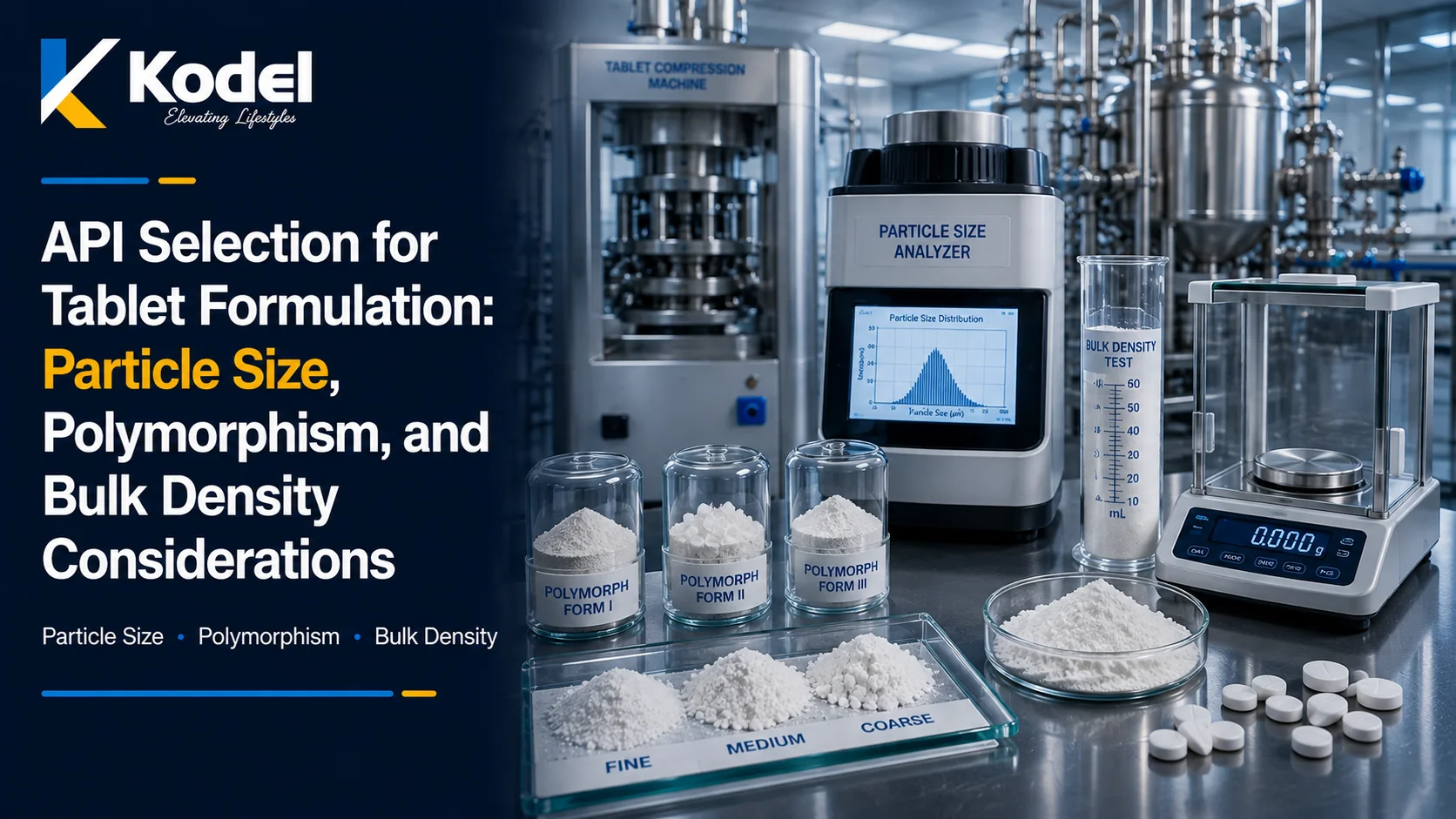
The US Pharmacopeia's guidance on particle size measurement and ICH Q6A guidance on specifications both treat particle size as a critical material attribute precisely because it is not cosmetic. A shift in an API's median particle size of even a few microns can move a tablet's dissolution profile outside its approved specification without any change to the formula itself. For extended-release actives like metoprolol succinate, or for a poorly soluble compound like piroxicam, that sensitivity turns API sourcing into a formulation decision, not just a procurement one.
Formulators frequently treat particle size, polymorphic form, and bulk density as manufacturing-site variables to control after sourcing rather than criteria to screen for during sourcing. That sequencing creates avoidable rework. This article sets out what to specify and verify for each attribute before selecting an API supplier for tablet formulation, using metoprolol succinate, metoprolol tartrate, and piroxicam as working examples.
Why Particle Size Distribution Drives Dissolution Behavior
Dissolution rate scales with surface area, and surface area scales inversely with particle size, so a finer particle size distribution generally dissolves faster for a given API, all else equal. For BCS Class II and Class IV compounds, where solubility rather than permeability limits absorption, this relationship is not academic: it can determine whether a generic formulation meets bioequivalence criteria against the reference product.
Regulatory guidance on particle size for BCS Class II and IV actives generally expects manufacturers to justify their specified particle size range with dissolution and, where relevant, bioequivalence data rather than setting the range arbitrarily. A formulator qualifying a new API supplier should request particle size distribution data, typically reported as d10, d50, and d90 values, across multiple production batches, not a single representative lot.
Polymorphism: The Hidden Variable in Solid Dosage Stability
Many small-molecule APIs can crystallise into more than one solid-state form, and different polymorphs of the same molecule can have meaningfully different solubility, dissolution rate, and physical stability. A metastable polymorph can convert to a more thermodynamically stable form during storage, changing the tablet's dissolution behavior months after manufacture even though the chemical identity of the API never changed.
Confirming polymorphic form through X-ray powder diffraction, and confirming that form remains consistent across manufacturing batches and after exposure to the tablet manufacturing process itself, such as wet granulation or compression, protects against a stability failure that would otherwise surface only late in a product's shelf life. A supplier that cannot produce XRPD data on request for a polymorph-sensitive molecule should be treated as a sourcing risk rather than a documentation oversight.
Bulk and Tapped Density: What They Predict About Tablet Manufacturability
Bulk density and tapped density, along with the Carr index calculated from them, predict how an API powder will flow and compress during tablet manufacturing. A low bulk density API with poor flow properties can cause weight variation during compression or require additional processing steps, such as wet or dry granulation, that a higher-density, free-flowing material would not need.
Requesting bulk density, tapped density, and Carr index data before selecting a supplier lets a formulation team anticipate whether direct compression is feasible or whether a granulation step should be built into the process from the start. This decision affects capital equipment needs, batch cycle time, and ultimately cost of goods, so it is worth resolving during API selection rather than during process development.
Particle Engineering for Extended-Release Metoprolol Succinate
Metoprolol succinate extended-release tablets typically rely on a matrix or multiparticulate system to control drug release over roughly 24 hours, and the API's particle size distribution directly affects how consistently that system performs. Kodel Life's metoprolol succinate API listing provides particle size specification data formulators can evaluate against their intended release mechanism before committing to a supplier.
Because extended-release performance is sensitive to particle size, formulators should request batch-to-batch particle size consistency data, not just a single specification range, when qualifying a metoprolol succinate supplier. A supplier whose particle size drifts between batches, even within a nominally acceptable range, can still produce a dissolution profile that shifts enough to complicate an annual product quality review.
Piroxicam API: Managing a Poorly Soluble, BCS Class II Compound
Piroxicam is a BCS Class II compound, meaning its absorption is limited primarily by solubility rather than permeability, which makes particle size reduction one of the more direct formulation levers available to improve its dissolution and bioavailability. Kodel Life's piroxicam API listing includes particle size and polymorph documentation relevant to formulators building both immediate-release tablet and capsule dosage forms.
Because piroxicam's dissolution is solubility-limited, formulators sometimes specify a micronised grade to increase surface area, and a supplier's ability to consistently deliver a micronised particle size specification across commercial-scale batches becomes a meaningful differentiator among piroxicam API manufacturers.
Specifying Material Attributes When You Issue an API RFQ
| Attribute | Why It Matters | Typical Data to Request |
| Particle size distribution | Drives dissolution rate, especially for BCS II/IV compounds | d10, d50, d90 across 3+ batches |
| Polymorphic form | Affects solubility and physical stability over shelf life | XRPD confirmation, post-process form check |
| Bulk and tapped density | Predicts flow and compressibility | Carr index, bulk/tapped density values |
| Residual solvents | Affects safety and long-term stability | ICH Q3C compliance data |
Building these attributes into the RFQ itself, rather than discovering gaps during formulation development, shortens the path from supplier selection to a stable, bioequivalent tablet formulation.
Treat Material Attributes as Sourcing Criteria, Not Manufacturing Afterthoughts
The formulators who avoid late-stage dissolution failures and stability surprises are the ones who screen for particle size, polymorphic form, and bulk density during supplier selection, not after a batch fails to meet specification. That shift in sequencing costs a few additional questions during the RFQ stage and saves months of rework later.
As more generic filings face bioequivalence scrutiny, API suppliers who can produce consistent, well-documented material attribute data across batches will increasingly separate themselves from suppliers offering only a certificate of analysis.