


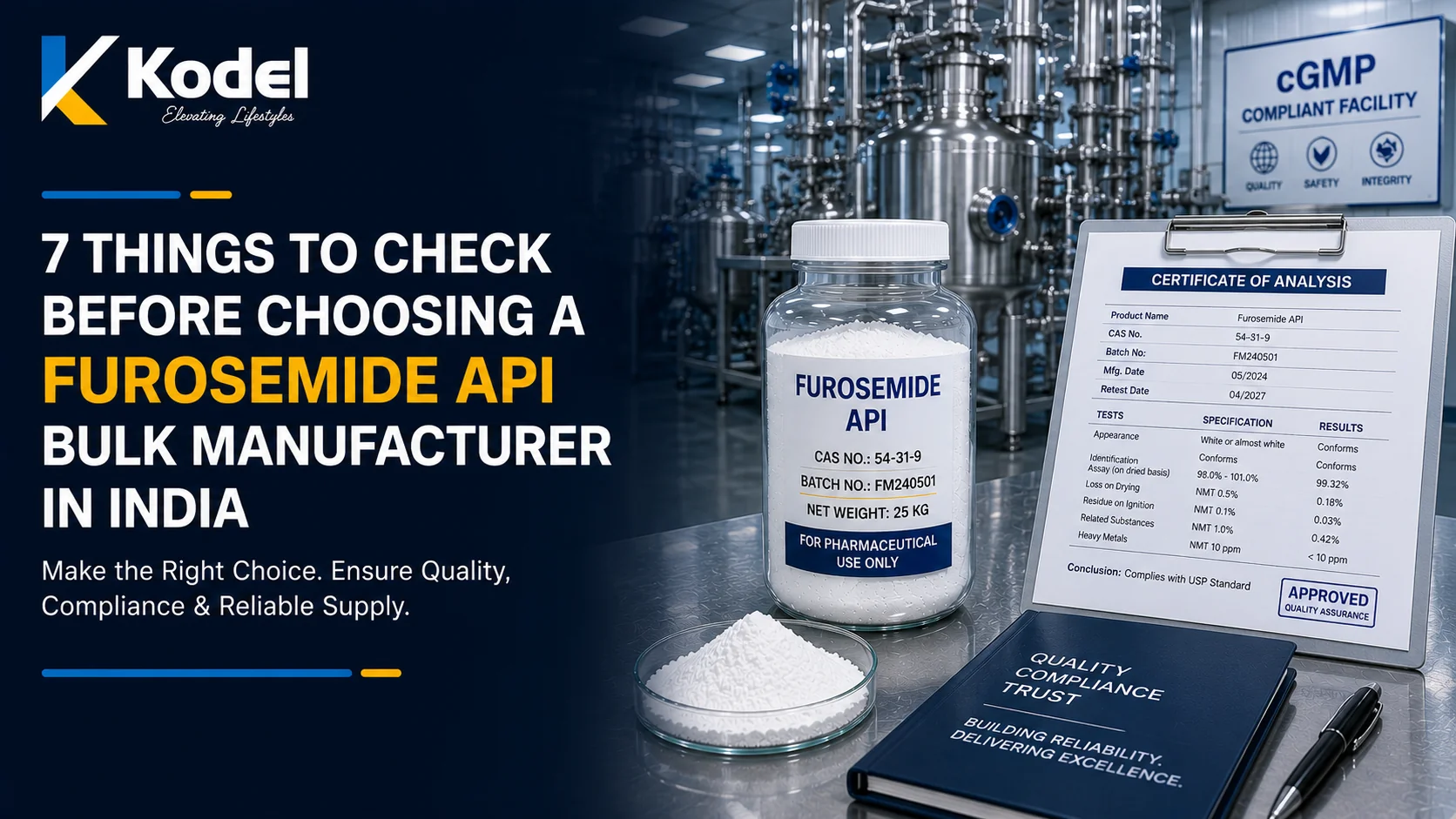
India supplies furosemide API to pharmaceutical manufacturers in over 40 countries. The country has the synthesis infrastructure, the raw material access, and the cost structure to compete globally in bulk API production. What it also has is significant variation in quality, compliance, and documentation standards across the hundreds of manufacturers offering furosemide in commercial volumes. A procurement team that does not apply a structured evaluation framework before committing to a supplier risks selecting one whose compliance record looks adequate on the surface but breaks down under regulatory scrutiny.
This listicle gives procurement managers, regulatory affairs teams, and formulation scientists seven specific criteria to verify before signing a furosemide API bulk supply agreement. Each criterion is grounded in what regulated-market buyers, FDA ANDA filers, and EU Marketing Authorisation holders actually need from a supplier, not what a supplier's marketing materials say they provide.
At a Glance: The 7 Criteria
| # | Criterion | What You Need to Confirm |
| 1 | GMP Certification | Active WHO-GMP, EU-GMP, or FDA standing — inspected within 3 years |
| 2 | Drug Master File (DMF) | Filed and active on FDA portal; equivalent CEP for EU supply |
| 3 | Certificate of Analysis Quality | Numeric assay values, named impurities, re-test date, pharmacopoeial reference |
| 4 | Production Capacity & Scheduling | Confirmed MT/month for furosemide specifically; batch queue lead time |
| 5 | Impurity Profile Depth | Named process impurities, ICH Q3A qualification, ICH M7 genotoxic assessment |
| 6 | Export Documentation Pack | COA + GMP cert + COO + MSDS (GHS) + DEA exemption (US) + HS 2942.00 |
| 7 | Technical Responsiveness | 48-hour response to queries; raw data (chromatograms) on request |
GMP Certification: Confirm the Authority, Scope, and Date
GMP certification is the baseline requirement for any furosemide API bulk manufacturer supplying regulated markets. The problem is that not all GMP certificates carry the same regulatory weight. A WHO-GMP certificate issued by India's Central Drugs Standard Control Organisation (CDSCO) covers WHO prequalification procurement and most semi-regulated markets. An EU-GMP certificate issued by a European competent authority such as the UK's MHRA, Austria's AGES, or France's ANSM demonstrates compliance with European Commission guidelines and is required for EU Marketing Authorisation drug substance sourcing. An FDA establishment inspection without outstanding critical observations is the requirement for ANDA-referenced furosemide API supply to the United States.
The three questions to ask every candidate manufacturer: Which authority issued your GMP certificate? What is the inspection date? Does the scope explicitly cover your furosemide API manufacturing line? A certificate issued more than three years ago without a subsequent re-inspection is functionally lapsed for regulatory filing purposes, regardless of what the paper says.
Kodel Life: Kodel Life's Morbi, Gujarat facility operates under ISO 9001:2015 Quality Management System certification and FDA-compliant cGMP manufacturing practices. The facility supplies furosemide API to 21 countries across 5 continents, with regulatory documentation tailored to each destination market's authority requirements.
Drug Master File Status: Active, Filed, and Referenceable
A US FDA Type II Drug Master File (DMF) for furosemide API is not optional for manufacturers supplying the US generic drug market. It is the mechanism by which a finished-dose ANDA filer references the drug substance manufacturer's confidential process, impurity, and stability data without disclosing it publicly. Without an active DMF on file, a furosemide API bulk manufacturer cannot support a US ANDA filing, which eliminates them from any supply chain that includes US-market generic finished doses.
Verify DMF status directly on the FDA's public Drug Master File database at accessdata.fda.gov. A DMF that appears on the database can be cross-checked for the holder name and submission date. For EU-market supply, ask whether the manufacturer holds an EDQM Certificate of Suitability (CEP) for furosemide API. An active CEP, verifiable on the EDQM website's public database, simplifies the EU MA dossier process and demonstrates that EDQM's own technical review team has assessed the manufacturing process independently.
See also: For a full explanation of DMF filing requirements and EDQM CEP differences, see: Complete Guide to Furosemide API
Kodel Life: Kodel Life provides DMF support and open/closed DMF reference letters as standard for furosemide API orders. Stability data per ICH Q1A and impurity profiles per ICH Q3A are included in the standard regulatory documentation package.
Certificate of Analysis Quality: Read It, Do Not Just Receive It
A Certificate of Analysis (COA) is the quality identity document for every furosemide API batch. Most buyers receive a COA. Fewer buyers read it with the scrutiny it deserves. The USP monograph for furosemide specifies a numeric assay range of 98.0 to 102.0 percent on dried basis, determined by HPLC. A COA that reports 'complies' for the assay without stating the actual percentage is not providing analytical data. Either the manufacturer is not running the quantitative test, or they are suppressing the result. Neither scenario is acceptable.
The related substances section is equally diagnostic. Furosemide synthesis produces identifiable process-related impurities at trace levels in all production batches. A COA reporting 'not detected' for all related substances without stating a detection limit is not credible. The question is not whether impurities are present at trace levels, it is whether those levels fall within the USP limit of 0.2 percent for any single impurity or the BP limit of 0.1 percent for specified impurities. Check also that the re-test date is at minimum 18 months from the intended delivery date. Batches manufactured more than 12 months before delivery with no re-testing record indicate poor stock management.
Kodel Life: Kodel Life issues batch-specific COAs to the specified pharmacopoeial standard: IP, BP, USP, or EP. All COAs include numeric assay values, individual impurity data, loss on drying, residue on ignition, particle size distribution, and water content by Karl Fischer titration.
Production Capacity and Scheduling Transparency
A manufacturer who lists their total API facility capacity as 50 MT per month may have only 5 MT per month allocated to furosemide synthesis at any given time. The relevant figure is not the facility headline capacity; it is the confirmed monthly production capacity for furosemide API specifically, and the manufacturer's current batch scheduling queue for your order volume and timeline.
Procurement teams sourcing furosemide API for commercial finished-dose production need clear answers on three capacity questions before committing to a supplier: What is the dedicated synthesis capacity for furosemide in MT per month? What is the current lead time for a batch of your required volume? How does the manufacturer handle force majeure situations such as raw material shortages, monsoon-related logistics disruption, or facility maintenance shutdowns? A manufacturer who cannot answer these questions with specific figures, rather than reassuring generalities, is not operating with the production management depth that commercial supply requires.
Kodel Life: Kodel Life produces furosemide API at 20 MT per month dedicated capacity from the Morbi, Gujarat facility. The commercial production infrastructure is separate from development-scale batching, ensuring commercial supply timelines are not disrupted by R&D scheduling.
Impurity Profile Depth: Named, Qualified, and ICH-Compliant
Process impurity management is where the technical gap between a commodity API supplier and a regulated-market API manufacturer is most visible. Under ICH Q3A, a drug substance manufacturer must identify impurities present above the reporting threshold, qualify impurities above the qualification threshold, and provide a justification or safety data for impurities that cannot be reduced below the qualification threshold. For furosemide API, this means identifying the specific names and structures of process-related impurities arising from the chlorosulfonation and amide bond formation steps in the synthesis route.
Additionally, ICH M7 requires a genotoxic impurity risk assessment for any impurity that contains an alert structural feature. Ask a prospective furosemide API bulk manufacturer whether they have conducted an ICH M7 assessment for their specific process, and whether any impurities in their synthesis route have been flagged as potentially genotoxic. A manufacturer who is not familiar with ICH M7 as it applies to their furosemide process is not operating at the quality system depth required for regulatory submission support in the EU or US markets.
See also: For a structured evaluation framework covering impurity profile questions and other criteria, see: How to Evaluate a Furosemide API Supplier
Kodel Life: Kodel Life provides impurity profiles per ICH Q3A guidelines as standard. Technical queries on impurity identification and ICH M7 assessment are handled by the in-house analytical team, with responses within 48 hours for qualified buyer enquiries.
Export Documentation Pack: Complete Before the Order Ships
A furosemide API bulk manufacturer who cannot produce a complete export documentation pack within five business days of a request is signalling that their documentation management is not ready for commercial volume supply. The minimum documentation pack for furosemide API export from India covers the batch COA with pharmacopoeial reference, a GMP certificate from the applicable authority, a GHS-compliant Material Safety Data Sheet (MSDS) to UN GHS Revision 9 or later, a Certificate of Country of Origin (COO) issued by a chamber of commerce or the Export Inspection Council of India, and HS code 2942.00 classification confirmation.
For US-bound shipments, the pack must also include a DEA controlled substance exemption statement, confirming furosemide is not scheduled under the US Controlled Substances Act. For EU-bound shipments, it must include either an EDQM CEP reference or a Qualified Person (QP) declaration confirming EU-GMP compliance. Buyers who discover documentation gaps only after an order has shipped face customs clearance delays, import authority holds, and in some cases, batch rejection at the point of entry into the destination country.
Kodel Life: Kodel Life's dedicated documentation team handles customs and import compliance documentation for all 21 export destination markets. Buyers receive a complete documentation package, including COA, GMP certificate, MSDS, COO, and market-specific regulatory support, before the shipment departs.
Technical Responsiveness: The Quality Signal Most Buyers Miss
Of all seven criteria on this list, technical responsiveness is the one most likely to be overlooked during supplier selection and most likely to determine supply relationship quality over time. A manufacturer who takes ten business days to respond to a question about their HPLC method system suitability criteria is revealing something important about how they handle joint investigations, deviation responses, and batch failure RCAs when a quality event occurs in a live commercial supply relationship.
Before awarding a commercial volume contract, test three categories of technical responsiveness: analytical data requests (ask for a raw HPLC chromatogram from a recent furosemide batch and note the response time and data quality), specification clarification (ask a technically specific question about particle size control methodology and assess the depth of the answer), and out-of-specification scenario response (ask how the manufacturer handles an OOS result during in-process testing and what their investigation and batch disposition protocol looks like). A manufacturer who responds thoroughly to all three categories within 48 hours, providing actual data rather than reassurances, is a manufacturer whose quality culture extends beyond the COA.
Kodel Life's technical team responds to qualified buyer enquiries within one to two business days. Raw analytical data including HPLC chromatograms, particle size reports, and stability data summaries are available on request for qualified procurement evaluations.
Apply All Seven, Not Just the Easy Three
Most procurement teams applying a vendor evaluation framework for furosemide API bulk manufacturers check GMP certification, COA, and price. The three criteria that most clearly differentiate a reliable long-term partner from a box-shifting commodity supplier are the ones that require active dialogue: impurity profile depth, technical responsiveness, and production capacity transparency. These three are also the ones most likely to expose a manufacturer who presents well on paper but cannot sustain compliance depth at commercial supply volumes.
The Indian pharmaceutical API manufacturing sector contains manufacturers who meet every criterion on this list at a globally competitive price point. The framework above is not designed to make sourcing harder. It is designed to make sure the supplier you select is one of them.
Download the API Sourcing Checklist: Get Kodel Life's complete furosemide API sourcing checklist as a downloadable PDF, or contact the team to request a COA, DMF reference letter, or bulk pricing quotation. Response within one to two business days.