


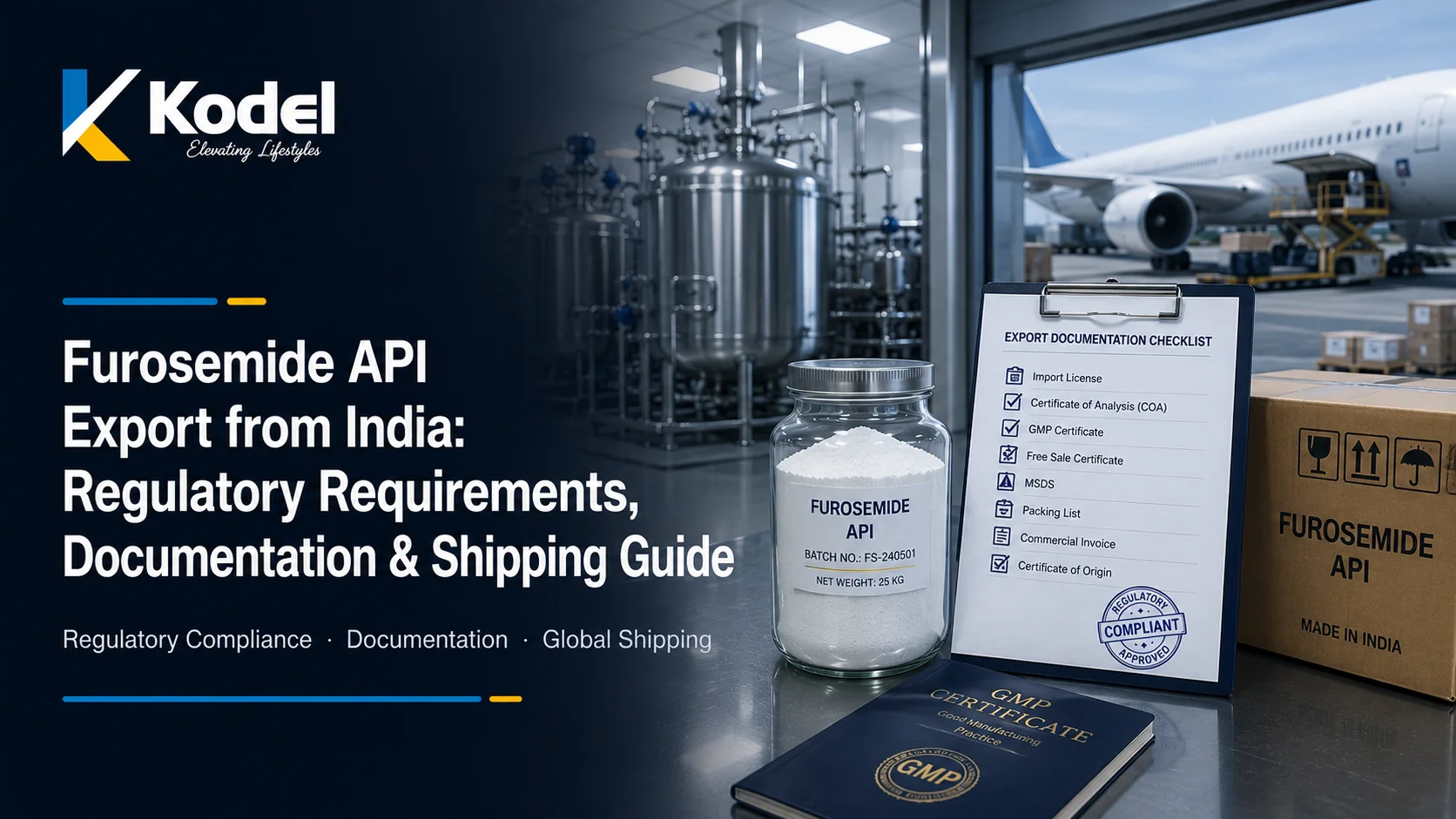
India accounts for approximately 20 percent of global API exports by volume, according to the Pharmaceuticals Export Promotion Council of India (Pharmexcil), with active pharmaceutical ingredients supplied to over 200 countries. Furosemide API, a loop diuretic used in the treatment of oedema and hypertension, is one of the established cardiovascular APIs produced and exported by Indian manufacturers to regulated markets in the United States, European Union, United Kingdom, and the Gulf Cooperation Council region. The combination of lower production cost, established synthesis capacity, and improving regulatory compliance credentials has made India a primary sourcing destination for international pharma buyers procuring furosemide API in bulk.
Exporting a regulated API is not a logistics exercise. It is a regulatory and documentation process that determines whether the material is accepted by the importing country's health authority, cleared by customs, and released for use in finished dosage form manufacture. International buyers evaluating Indian furosemide API suppliers need to understand the specific regulatory requirements for their target market, the documentation their supplier must be able to produce, and the shipping conditions that maintain product integrity in transit. This guide covers each of those areas in full.
Why India Is a Primary Furosemide API Sourcing Market
The Indian pharmaceutical manufacturing sector produced APIs worth approximately 11.8 billion US dollars in the financial year 2023 to 2024, according to the Indian Pharmaceutical Alliance. Furosemide API manufacture in India is concentrated among cGMP-certified manufacturers in pharmaceutical manufacturing clusters in Maharashtra, Gujarat, Telangana, and Andhra Pradesh, with several manufacturers holding active Drug Master File (DMF) registrations with the US Food and Drug Administration and Certificate of Suitability (CEP) approvals from the European Directorate for the Quality of Medicines and HealthCare.
The cost advantage of Indian furosemide API relative to European and US domestic production is significant. Buyers in the EU and US typically procure Indian-origin furosemide API at 30 to 50 percent below comparable European-manufactured material, with the regulatory quality gap having closed substantially as Indian manufacturers invested in US FDA and EU GMP compliance over the 2015 to 2025 period. The WHO Prequalification Programme, which certifies API manufacturers for use in procurement by UN agencies and low-to-middle-income country health programmes, has certified multiple Indian furosemide API producers, providing an internationally recognised quality benchmark for buyers in markets that do not run their own GMP inspection programmes.
Regulatory Requirements by Target Market
United States (US FDA)
Furosemide API exported from India for use in US-market finished drug products must be manufactured at a facility registered with the US FDA under 21 CFR Part 207. The API itself must be supported by a Type II Drug Master File (DMF) filed with the FDA, which documents the manufacturing process, impurity profile, specifications, and validation data in a format that allows a finished drug product manufacturer to reference the DMF in their Abbreviated New Drug Application (ANDA) or New Drug Application (NDA) without the API manufacturer disclosing proprietary data to them.
Buyers procuring furosemide API for US-market products should confirm three things at supplier qualification stage: that the manufacturing facility has been inspected by the US FDA with no unresolved Warning Letter or Import Alert on record; that an active DMF is filed for the specific furosemide API product and facility; and that the DMF has been referenced by at least one approved ANDA, which is evidence that the FDA has reviewed and found the DMF acceptable. An API supplier can hold a DMF without it having been reviewed by the FDA, so the distinction between a filed and reviewed DMF is material. The FDA's online DMF database, accessible through the FDA website, allows buyers to verify DMF status, filing date, and whether any deficiency letters have been issued.
European Union and United Kingdom (EDQM CEP)
API exported to the EU and UK for use in finished medicinal products must comply with the relevant monograph in the European Pharmacopoeia (Ph.Eur.), and the manufacturer must demonstrate compliance through a Certificate of Suitability (CEP) issued by the European Directorate for the Quality of Medicines and HealthCare (EDQM). The CEP system allows a finished product manufacturer to reference the API manufacturer's CEP in their Marketing Authorisation application, rather than providing full API manufacturing data themselves.
Furosemide is listed in the European Pharmacopoeia (Ph.Eur. monograph 0391), with specifications covering assay, related substances, heavy metals, loss on drying, and sulphated ash. An Indian furosemide API supplier exporting to EU markets must hold a valid EDQM CEP for the specific manufacturing site, with the CEP covering the relevant manufacturing route and impurity profile. Buyers should verify that the CEP is current (not under revision or suspended) and that the manufacturing site listed on the CEP matches the actual production facility. Site changes require CEP variation approval before export can continue to EU-regulated customers.
For the UK post-Brexit, the Medicines and Healthcare products Regulatory Agency (MHRA) accepts EDQM CEPs for API sourcing in products seeking UK Marketing Authorisation, under a mutual recognition arrangement that remained in place following the UK's departure from the EU. Buyers targeting both EU and UK markets can typically satisfy both requirements with a single EDQM CEP, though the finished product manufacturer's UK Marketing Authorisation dossier must reference the MHRA acceptance position.
Gulf Cooperation Council (GCC)
Pharma regulatory requirements in Saudi Arabia, UAE, Qatar, Kuwait, Bahrain, and Oman are administered by the Gulf Central Committee for Drug Registration (GCC-DR), with country-specific additional requirements from health authorities including the Saudi Food and Drug Authority (SFDA) and UAE Ministry of Health and Prevention (MOHAP). API exported to GCC markets for use in registered finished products generally requires that the API manufacturer holds a WHO-GMP certificate or a GMP certificate from a recognised regulatory authority (EU GMP, US FDA inspection clearance), and that the API meets USP or Ph.Eur. specifications.
The SFDA operates its own GMP inspection programme for API manufacturers supplying Saudi-registered products, with inspections conducted either directly or by reliance on inspections from recognised authorities. Indian furosemide API manufacturers holding US FDA clearance or EU GMP certificates in good standing are generally eligible for acceptance by SFDA without a separate GCC inspection. Buyers procuring for GCC markets should confirm the specific health authority requirements in the target country, as GCC harmonisation is ongoing and country-level requirements still vary.
Documentation Requirements for Furosemide API Export
A complete export documentation package for furosemide API from India covers regulatory documents, quality documents, and commercial shipping documents. Buyers should specify the full documentation set required at the enquiry stage rather than requesting documents piecemeal after order placement, as some documents (particularly regulatory certificates) take time to prepare and issue.
Regulatory and Quality Documents
The core quality documentation set for a furosemide API export shipment from India comprises the Certificate of Analysis (COA), which reports test results against specification for the specific batch being shipped. The COA must be issued on the manufacturer's letterhead with batch number, manufacturing date, retest date or expiry date, and results for all compendial and in-house specification tests. International buyers should verify that the COA references the applicable pharmacopoeial monograph (USP, Ph.Eur., or BP) and that all test results include the method reference, specification limit, and actual result.
Beyond the COA, buyers procuring for regulated markets will require the Manufacturer's Authorisation Licence (Manufacturing Licence issued by the Central Drugs Standard Control Organisation, CDSCO, in India), the WHO-GMP certificate or applicable regulatory authority GMP certificate for the manufacturing site, and a copy of the US FDA DMF acknowledgment letter or EDQM CEP for the target market. For shipments to markets requiring import licences for API (including several GCC countries), the buyer must obtain the import licence from their local health authority before shipment can be declared.
Stability data is increasingly requested by buyers at the qualification stage rather than at shipment. A real-time stability study under ICH Q1A(R2) conditions (25 degrees Celsius and 60 percent relative humidity for Zone II markets, or 30 degrees Celsius and 65 percent relative humidity for Zone IVb markets including India) must support the claimed retest period. Buyers in tropical markets should confirm that stability data covers the relevant ICH climatic zone for their geography.
Commercial Shipping Documents
The commercial shipping document set for furosemide API export from India includes the commercial invoice, packing list, bill of lading or airway bill, Certificate of Origin (issued by the Federation of Indian Export Organisations or an authorised Chamber of Commerce), and, where applicable, a phytosanitary certificate or fumigation certificate. A shipping declaration confirming compliance with IATA and IMDG packaging regulations applies for air and sea freight respectively.
Furosemide API is a pharmaceutical chemical requiring proper classification under the Harmonised System (HS code 2942.00 for organic compounds, or the more specific pharmaceutical HS codes used by individual countries). Buyers should confirm the correct HS classification for furosemide API in the importing country with their customs broker before the first shipment, as misclassification is a common cause of customs delays and, in some markets, duty recalculation.
Packaging and Shipping Conditions
Furosemide API is typically supplied in double-polyethylene-lined, UN-approved fibre drums or HDPE containers, with packaging integrity maintained for the claimed retest period under the appropriate ICH storage condition. Standard pack sizes range from 5 kg to 25 kg per container for export shipments, with larger drum packs available for high-volume procurement.
Storage and transport conditions for furosemide API per ICH Q1A(R2) are controlled temperature, not exceeding 30 degrees Celsius, and protected from light. Shipments transiting through high-temperature logistics corridors, including Middle East hub airports and seaports during summer months, require thermal monitoring during transit. Buyers should specify whether temperature data loggers are required with each shipment, as this is becoming standard practice for regulated market import acceptance in the EU and increasingly required by US FDA for API shipped by air to US-registered facilities.
Cold chain is not required for furosemide API under standard storage conditions. Air freight is typically used for smaller or urgent shipments, while sea freight in container loads is the standard mode for bulk procurement above 50 kg per order. Sea transit times from Indian west coast ports (JNPT Mumbai, Mundra) to European ports average 20 to 28 days; to US East Coast ports, 25 to 35 days; to GCC ports, 10 to 16 days.
How to Evaluate an Indian Furosemide API Supplier for Export
The single most reliable indicator of a compliant Indian furosemide API manufacturer is a clean regulatory inspection record with at least one recognised authority. A manufacturer with a US FDA Establishment Inspection Report (EIR) classification of Voluntary Action Indicated (VAI) or Official Action Indicated with resolved observations, or a current EU GMP certificate issued after a satisfactory inspection, has demonstrated that its quality management system meets the standards required for regulated market supply.
Beyond inspection status, buyers should evaluate four additional supplier characteristics before placing an export order. First, DMF or CEP status for the specific target market, as described above. Second, the supplier's impurity profile for furosemide API relative to ICH Q3A limits for related substances and degradation products, which determines whether the material is suitable for the buyer's formulation without additional purification. Third, the supplier's track record of on-time delivery and batch consistency across multiple orders, which can be assessed through reference checks with existing customers in the same target market. Fourth, the supplier's willingness to participate in a Quality Technical Agreement (QTA), which formalises responsibilities for change notification, batch release, deviation reporting, and audit rights, and is a regulatory requirement under EU GMP (EudraLex Volume 4, Chapter 7) for API supply to EU-registered finished product manufacturers.
Kodellife manufactures furosemide API at a cGMP-certified facility with regulatory documentation available for US, EU, and GCC market buyers. Enquiries for export documentation packages, stability data, and COA samples can be directed through the product page or the export quote request form.
Getting Your First Export Shipment Right
The regulatory complexity of furosemide API export from India is real, but it is predictable. Every requirement covered in this guide, from DMF filing to CEP verification to QTA execution, follows a documented path that established Indian API manufacturers have navigated repeatedly. The buyers who experience delays, customs holds, or regulatory non-acceptance are almost always buyers who treated documentation as an afterthought rather than a parallel process to procurement.
The practical sequence for a first furosemide API import from India is: confirm the regulatory requirement for your target market before supplier selection; qualify the supplier against inspection status, DMF or CEP availability, and impurity profile before placing a trial order; execute the Quality Technical Agreement before the first commercial shipment; and obtain import licence clearance in your market (where required) before the shipment is dispatched. This sequence adds two to eight weeks to the initial procurement timeline and eliminates the risk of a shipment being held or rejected at the border.
Indian furosemide API manufacturing capacity is more than sufficient to meet international demand. The variable is supplier selection and documentation preparation. Buyers who invest in a structured qualification process receive material that enters their production without regulatory friction, on a supply relationship that scales as their volume grows.