


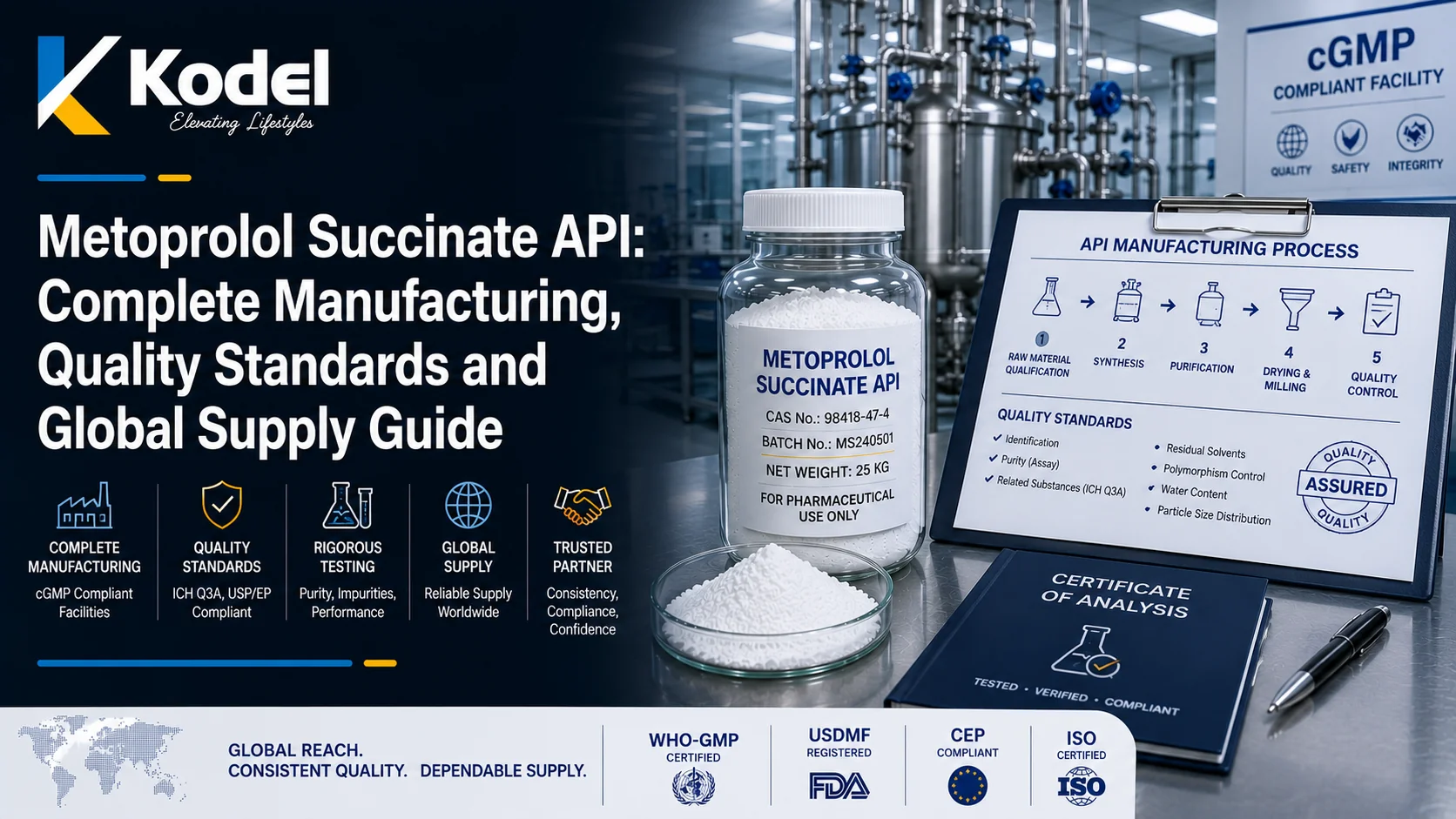
The global beta-blocker market was valued at approximately 23 billion US dollars in 2024 and is projected to grow at a compound annual rate of 5.3 percent through 2030, according to industry analysis from Grand View Research. Metoprolol Succinate, the extended-release salt form of metoprolol, is one of the most widely prescribed beta-blockers in that market. Its superiority over the immediate-release tartrate salt in once-daily dosing and cardiovascular outcome profiles, demonstrated in the MERIT-HF trial, which enrolled 3,991 patients with chronic heart failure, has made it the reference formulation for extended-release beta-blocker therapy in major regulatory markets including the United States, European Union, and Japan.
For pharmaceutical manufacturers producing generic Metoprolol Succinate extended-release tablets, the API sourcing decision is one of the most consequential steps in the product development process. The ER-grade API specification for Metoprolol Succinate differs materially from standard pharmaceutical-grade material, and not all Indian API manufacturers supply material with the controlled physical characteristics, particle size specification, and stability data depth that ER formulation development and regulatory filing require.
This guide covers the full landscape of Metoprolol Succinate API manufacturing from India: the chemistry, the pharmacopoeial quality standards, the ER-grade specifications that matter for formulation, the regulatory documentation a buyer needs for US ANDA and EU MA filings, and the criteria that define a reliable long-term API supplier in this therapeutic category.
What Is Metoprolol Succinate API and Why the Succinate Salt Matters
Metoprolol Succinate (CAS 98418-47-4, molecular formula C34H56N2O10, molecular weight 652.8 g/mol) is the succinic acid salt of metoprolol, a selective beta-1 adrenoceptor antagonist. The succinate salt was developed specifically to enable extended-release tablet formulation technology. Where Metoprolol Tartrate dissolves rapidly and produces a peak plasma concentration within 1.5 to 2 hours after oral administration, Metoprolol Succinate in an ER matrix releases metoprolol at a controlled rate over 24 hours, producing a steady-state plasma profile that reduces peak-to-trough fluctuation and supports once-daily dosing compliance.
The clinical significance of this pharmacokinetic difference is substantial. The MERIT-HF trial, published in The Lancet in 1999, demonstrated a 34 percent reduction in all-cause mortality in heart failure patients treated with Metoprolol Succinate extended-release versus placebo over a mean follow-up period of one year. This outcome data established Metoprolol Succinate as the guideline-recommended beta-blocker for heart failure with reduced ejection fraction across ACC/AHA and ESC cardiology guidelines, a status it retains as of 2026.
The chemical difference between the succinate and tartrate salts matters beyond clinical pharmacology. For API manufacturers, the two salts require different synthesis routes and produce different physical characteristics. Metoprolol Succinate crystallises as a white crystalline powder with a specific crystalline polymorph that affects dissolution behaviour in ER tablet matrices. Manufacturers who do not control polymorph consistency across production batches introduce dissolution variability that propagates into finished-dose in-vitro dissolution testing failures, even when the API assay is fully within pharmacopoeial specification.
Pharmacopoeial Quality Standards: BP, USP, EP and IP Specifications
Metoprolol Succinate API is described in the British Pharmacopoeia, European Pharmacopoeia, United States Pharmacopeia, and Indian Pharmacopoeia. Kodel Life manufactures Metoprolol Succinate to all four pharmacopoeial grades from a single Morbi, Gujarat facility, allowing buyers to specify the grade appropriate for their target registration market without requiring separate supply arrangements.
The USP and BP/EP monographs share broadly similar specification parameters but differ in assay limits and specific impurity thresholds. The table below sets out the principal specification parameters across both monograph families.
| Specification Parameter | USP Requirement | BP / EP Requirement |
| Assay (anhydrous basis) | 98.0% to 102.0% | 99.0% to 101.0% |
| Appearance | White to off-white crystalline powder | White crystalline powder |
| Melting Point | 120 to 124 degrees Celsius | 120 to 124 degrees Celsius |
| Related Substances (single) | NMT 0.2% | NMT 0.1% (specified) |
| Water Content (KF) | NMT 0.5% | NMT 0.5% |
| Residue on Ignition | NMT 0.1% | NMT 0.1% |
| Optical Rotation | +/- 0.10 degrees (anhydrous) | Complies Ph. Eur. 2.2.7 |
| pH (5% aqueous solution) | 5.5 to 7.5 | Not specified separately |
| Heavy Metals | NMT 20 ppm | Complies Ph. Eur. 2.4.8 |
The tighter BP/EP assay range of 99.0 to 101.0 percent, compared to the USP range of 98.0 to 102.0 percent, is the most practically significant difference between the two monograph families. Manufacturers producing for EU-market ANDA or MA-equivalent filings must demonstrate consistent batch performance within the narrower range. A supplier who cannot achieve consistent results in the 99.0 to 101.0 percent assay window across multiple production batches is not producing material to a standard that EU regulatory reviewers will accept for drug substance characterisation.
Extended-Release Grade Specifications: What ER Formulation Actually Requires
Pharmacopoeial compliance is necessary but not sufficient for Metoprolol Succinate API destined for extended-release tablet formulation. The ER dosage form imposes additional physical specification requirements on the API that are not captured in USP or BP monographs but are critical to finished-dose dissolution performance and batch-to-batch reproducibility.
Particle Size Distribution
Metoprolol Succinate ER tablet technology typically uses polymer matrix or membrane-controlled release systems where the API particle size affects drug loading uniformity, granulation behaviour, and ultimately the in-vitro dissolution profile. Procurement teams developing Metoprolol Succinate ER formulations should specify D10, D50, and D90 particle size parameters, measured by laser diffraction, in their API specification. A D90 above 150 microns may require additional milling before granulation; excessive fines (D10 below 10 microns) can affect flow properties and content uniformity. A qualified supplier should be able to provide API to a specified particle size range and demonstrate batch-to-batch consistency in that range through particle size data across a minimum of three consecutive commercial batches.
Polymorph Control
Metoprolol Succinate exists in multiple polymorphic forms. The commercially relevant polymorph for ER tablet formulation is the thermodynamically stable form, characterised by its specific X-ray powder diffraction (XRPD) pattern and differential scanning calorimetry (DSC) profile. A change in polymorph arising from variation in crystallisation conditions during API manufacturing can alter the dissolution behaviour of the finished ER tablet even when all other API specification parameters remain within limits. Manufacturers with robust crystallisation process controls and validated XRPD monitoring as part of their in-process control programme provide meaningful assurance of polymorph consistency. Ask any prospective supplier to provide their DSC and XRPD data and confirm that polymorph identity is part of their standard batch release specification.
Bulk Density and Flow Properties
For tablet manufacturing, the bulk density and Carr's index (a measure of powder compressibility) of the Metoprolol Succinate API affect granulation behaviour and tablet press performance. ER tablet formulations with high API loading are particularly sensitive to batch-to-batch variation in these physical properties. A supplier who measures and reports bulk density, tapped density, and Carr's index as part of their standard COA provides formulation teams with the physical property data they need to maintain process consistency across API batches from different production lots.
Metoprolol Succinate API Manufacturing: Synthesis Route and GMP Controls
Metoprolol Succinate synthesis involves the production of metoprolol free base through a multi-step route starting from para-methoxyphenol, followed by salt formation with succinic acid under controlled crystallisation conditions. The synthesis requires careful control of reaction stoichiometry, temperature profiles during the exothermic alkylation steps, and crystallisation parameters in the final salt formation stage, as these variables determine both the chemical purity of the API and the polymorph consistency of the final crystalline product.
Under ICH Q7, the cGMP framework for API manufacturing, the manufacturer must define and validate the synthesis route, identify critical process parameters (CPPs) at each stage, establish in-process control (IPC) limits for key intermediates, and maintain batch manufacturing records (BMRs) that document every deviation from the validated process. For Metoprolol Succinate specifically, the critical process parameters include reaction temperature in the alkylation steps, pH at critical stages, solvent quality for the crystallisation step, and drying temperature and duration for the final API cake, as elevated drying temperatures can induce polymorph conversion.
Kodel Life is Morbi, Gujarat facility manufactures Metoprolol Succinate API under ISO 9001:2015 Quality Management System protocols and FDA-compliant cGMP practices. The facility operates dedicated synthesis infrastructure for beta-blocker APIs with validated process parameters, in-process control checkpoints, and a QC laboratory equipped for HPLC assay, related substances, particle size, XRPD polymorph identification, and Karl Fischer water content determination.
Process impurity management for Metoprolol Succinate follows ICH Q3A guidelines. The principal process-related impurities arising from the synthesis route include metoprolol-related alkylation by-products and oxidative degradation products. A cGMP manufacturer maintains a fully characterised impurity profile with named impurities, quantitative HPLC limits, and a genotoxic impurity risk assessment per ICH M7 for any impurity carrying an alert structural feature. Buyers requesting regulatory support documentation for ANDA or MA filings should confirm that the supplier's impurity profile documentation is current and covers all impurities identified in the ICH Q3A submission.
Regulatory Documentation for Metoprolol Succinate API: DMF, CEP and Dossier Support
Metoprolol Succinate API is a high-demand molecule in the global generic cardiovascular drug market. Multiple ANDA approvals for Metoprolol Succinate ER tablets are active in the US market, and European generic MA holders source the API from a pool of qualified Indian and European manufacturers. Buyers entering or expanding in either market need a supplier who can provide the regulatory documentation package that supports the drug substance section of their dossier.
US Market: FDA Drug Master File
A Type II Drug Master File submitted to the FDA under 21 CFR 314.420 is the standard mechanism for Metoprolol Succinate API manufacturers to support US ANDA filings. The DMF covers the full manufacturing process, starting material sourcing, impurity qualification, analytical methods with validation data, and stability data under ICH Q1A conditions. The ANDA filer references the DMF number in their drug product application; the FDA reviews the DMF in conjunction with the ANDA review cycle. A supplier who cannot provide a DMF number verifiable on the FDA's public access database cannot support a US ANDA filing, regardless of their COA quality or price competitiveness.
EU Market: EDQM Certificate of Suitability
For EU Marketing Authorisation holders, the EDQM Certificate of Suitability (CEP) for Metoprolol Succinate API provides the drug substance reference for the dossier Module 3 drug substance section. An active CEP, issued following EDQM technical review and facility inspection, allows the MA holder to replace a full drug substance description in their dossier with a CEP reference. Buyers supplying the EU market should ask prospective suppliers whether they hold an active CEP for Metoprolol Succinate, confirm the CEP scope covers the applicable pharmacopoeial grade, and verify the CEP status on the EDQM public database.
See also: For a detailed explanation of how DMF and CEP filings work in practice across regulatory markets, see our pillar guide: Complete Guide to Furosemide API Global Supply
Stability Data and ICH Q1A Compliance
Metoprolol Succinate API has an established re-test period of 24 to 36 months under ICH Q1A long-term storage conditions (25 degrees Celsius / 60 percent relative humidity). Accelerated stability data at 40 degrees Celsius / 75 percent RH for six months is required to support the re-test date claim in a regulatory filing. Buyers should request stability data summaries from any prospective supplier, confirm that the data covers the specific pharmacopoeial grade they intend to purchase, and verify that the stability protocol is conducted on commercial-scale batches rather than laboratory-scale development material.
Metoprolol Succinate vs Metoprolol Tartrate: The API Sourcing Implications
Pharmaceutical procurement teams sometimes evaluate whether to source Metoprolol Succinate or Metoprolol Tartrate API, particularly when a formulation brief specifies metoprolol without mandating the salt form. The two salts are not interchangeable at the API sourcing level, and the procurement and regulatory implications of choosing one over the other are significant.
| Comparison Dimension | Metoprolol Succinate | Metoprolol Tartrate |
| CAS Number | 98418-47-4 | 56392-17-7 |
| Primary Dosage Form | Extended-release (ER) tablet | Immediate-release (IR) tablet / injection |
| Dosing Frequency | Once daily | Two to four times daily (IR) |
| Key Clinical Evidence | MERIT-HF (mortality reduction, HF) | Established IR beta-blocker |
| API Particle Size Control | Critical for ER dissolution | Less critical for IR |
| Polymorph Control | Mandatory for ER performance | Less critical |
| Kodel Life Capacity | 20 MT per month | 62 MT per month |
| Pharmacopoeial Grades | IP, BP, USP, EP | IP, BP, USP, EP |
The 62 MT per month production capacity for Metoprolol Tartrate at Kodel Life reflects the larger immediate-release market volume, where the tartrate salt is used in branded and generic IR tablets, injectable formulations, and combination cardiovascular products. The 20 MT per month Metoprolol Succinate capacity is dedicated to the ER-grade API market, where tighter physical specification controls and smaller batch volumes reflect the more specialised nature of ER formulation supply chains.
Metoprolol Succinate API Export from India: Markets, Documentation and Logistics
India's position as a leading global supplier of cardiovascular APIs is well established. The country's API manufacturing infrastructure has supported the generic cardiovascular drug market for over two decades, and Metoprolol Succinate API exports from Indian manufacturers reach pharmaceutical companies in Southeast Asia, South Asia, the Middle East, Africa, Europe, and the Americas. The documentation and logistics requirements for Metoprolol Succinate API export follow the same regulatory framework as other pharmaceutical APIs but carry specific requirements related to the ER-grade physical specifications that buyers must confirm before placing commercial orders.
A complete export documentation pack for Metoprolol Succinate API from India includes the batch-specific COA referencing the applicable pharmacopoeial standard, a GMP certificate from the relevant authority (WHO-GMP, EU-GMP, or FDA compliance documentation), a GHS-compliant Material Safety Data Sheet, a Certificate of Country of Origin, HS code classification documentation (HS code 2942.00 for other organic compounds), and for US-bound shipments, a DEA controlled substance exemption statement confirming Metoprolol Succinate is not scheduled under the US Controlled Substances Act.
Kodel Life: Kodel Life exports Metoprolol Succinate API to 21 countries across 5 continents including the USA, Germany, Thailand, UAE, Kenya, Bangladesh, and Brazil. The in-house documentation team handles all customs and import compliance paperwork for each destination market. DMF reference letters, CEP copies, and eCTD-compatible documentation packages are provided as standard for regulated-market buyers.
For ER-grade API shipments specifically, buyers should confirm packaging specifications match their internal handling requirements: pharmaceutical-grade polyethylene inner bags inside fibre drums or HDPE containers, with humidity and light protection as specified by the API stability data. Storage conditions for Metoprolol Succinate API are typically at or below 25 degrees Celsius, protected from moisture and light, with a re-test period of 24 to 36 months from the date of manufacture. Confirm the re-test date on the COA is at minimum 18 months beyond the anticipated date of use in finished-dose manufacturing.
How to Evaluate a Metoprolol Succinate API Manufacturer: Six Critical Criteria
The evaluation framework for a Metoprolol Succinate API manufacturer extends the standard API supplier assessment with ER-grade-specific criteria that reflect the molecule's formulation demands. Six criteria define a manufacturer capable of supporting commercial ER tablet production.
1. GMP Certification With Confirmed Scope
Verify that the GMP certificate explicitly covers the Metoprolol Succinate API manufacturing line, not just the general facility. Request the inspection date and issuing authority. WHO-GMP, EU-GMP, and FDA EIR standing are the three relevant certifications for regulated-market supply.
2. ER-Grade Particle Size Specification
Confirm that the manufacturer controls D10, D50, and D90 particle size parameters and can supply material within the range your formulation development requires. Request batch particle size data for a minimum of three recent commercial batches to assess consistency.
3. Polymorph Identity Testing
Ask whether XRPD polymorph identification is part of the standard batch release specification. A manufacturer who does not routinely test for polymorph identity cannot provide assurance that crystallisation process variations have not introduced a different polymorph into a commercial batch.
4. Active DMF or CEP Status
Verify DMF status on the FDA public database for US-market supply. For EU-market supply, confirm CEP status on the EDQM public database. A manufacturer who cannot provide a verifiable DMF number or CEP reference cannot support regulatory filings in regulated markets.
5. ICH Q3A Impurity Profile With ICH M7 Assessment
Request the impurity profile document covering all process-related impurities with named identities, quantitative limits, and ICH Q3A qualification status. Confirm that an ICH M7 genotoxic impurity risk assessment has been conducted for the Metoprolol Succinate synthesis route.
6. Stability Data Depth
Request ICH Q1A long-term and accelerated stability data for the specific grade and lot you intend to purchase. Confirm the data covers commercial-scale batches and that the re-test period claim is supported by real stability data, not extrapolation from development-scale material.
Source the API That the Formulation Actually Needs
Metoprolol Succinate API is not a commodity purchase in the way that a standard small-molecule API might be. The ER dosage form that defines its therapeutic advantage also defines a set of physical specification requirements for the API that are invisible to a buyer looking only at the COA assay result. Particle size distribution, polymorph consistency, and bulk density all influence whether an ER tablet manufactured from a given API lot will pass dissolution testing and deliver the pharmacokinetic profile the regulatory submission describes.
Kodel Life supplies Metoprolol Succinate API to IP, BP, USP, and EP pharmacopoeial standards from the Morbi, Gujarat facility, with 20 MT per month dedicated capacity, ER-grade particle size specification control, and a complete regulatory documentation package including DMF support, ICH Q1A stability data, and ICH Q3A impurity profiles. The technical team responds to qualified buyer enquiries within one to two business days.
Buyers evaluating a Metoprolol Succinate API manufacturer for ER tablet development or commercial supply should apply the six criteria in this guide as their evaluation protocol, not as a post-selection checklist. The investment in thorough supplier qualification before a first commercial order is measurable. The cost of discovering a polymorph inconsistency or an ER dissolution failure after scale-up is not.
Request a Metoprolol Succinate API Quote Contact Kodel Life to request a Certificate of Analysis, DMF reference letter, particle size data, or bulk pricing quotation for Metoprolol Succinate API. Responses within one to two business days. Call +91 75023 33335 or email info@kodellife.com.