


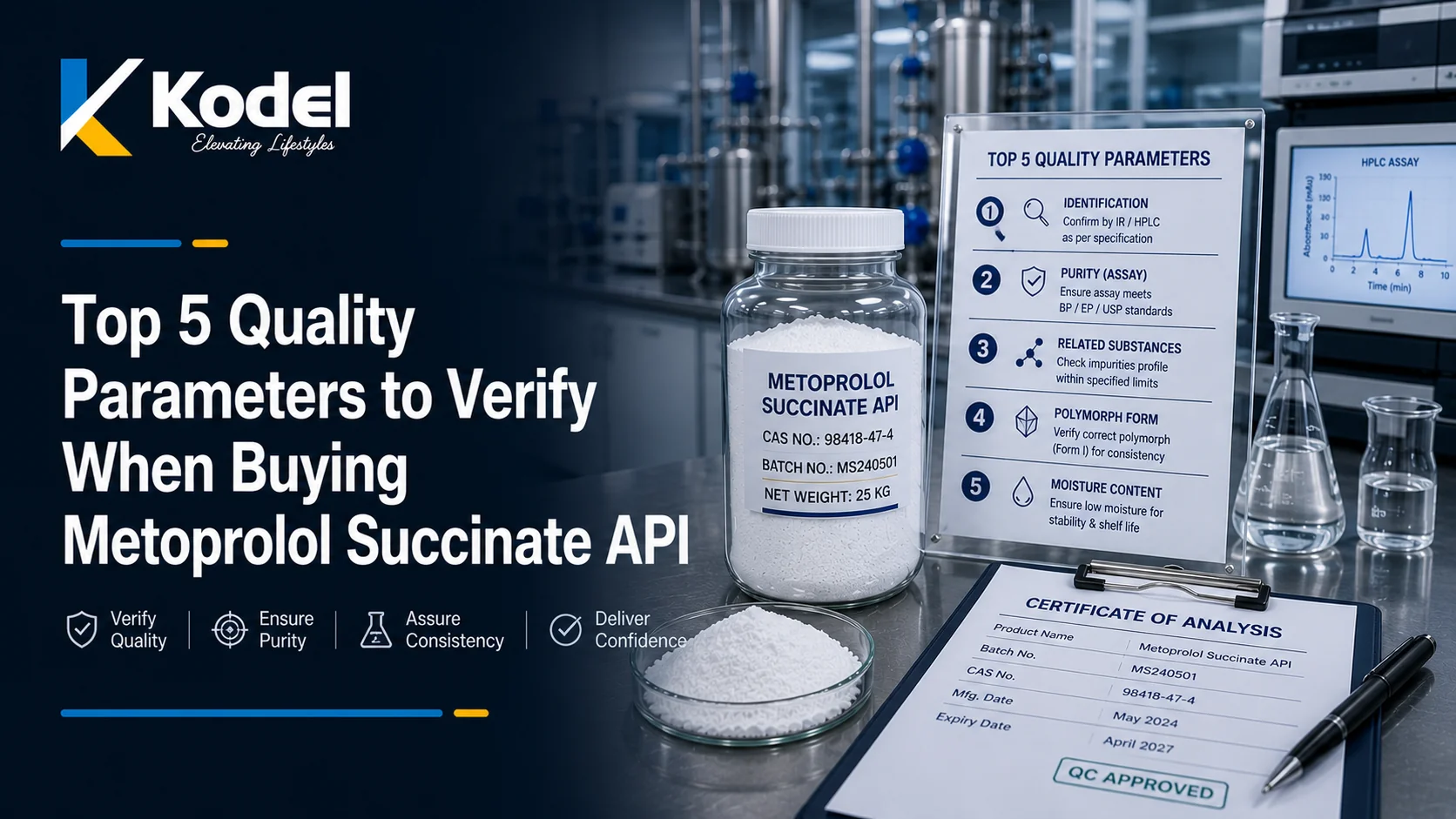
Procurement teams buying Metoprolol Succinate API face a market with dozens of Indian manufacturers offering the molecule, most of them with a COA that shows assay compliance and a GMP certificate on letterhead. The parameters that most reliably predict whether a batch of Metoprolol Succinate API will perform correctly in an ER tablet formulation, pass dissolution testing, and support a regulatory filing without queries are the ones that fewer suppliers measure routinely and fewer buyers ask for systematically.
This listicle identifies the five quality parameters that matter most for Metoprolol Succinate API procurement, with specific questions to ask your supplier, specific results to look for in their documentation, and specific red flags that should send you to the next supplier on your shortlist.
At a Glance: The 5 Parameters
| # | Quality Parameter | What Good Looks Like (Green) | Red Flag (Stop) |
| 1 | Assay — Numeric, Pharmacopoeial | 99.0-101.0% (BP/EP) or 98.0-102.0% (USP), numeric value on COA | COA states 'complies' without a percentage |
| 2 | Polymorph Identity (XRPD) | XRPD diffractogram confirming thermostable form; batch release test | Not tested routinely; 'same as reference' without data |
| 3 | Particle Size (D10/D50/D90) | Laser diffraction data across 3 consecutive batches; D90 in agreed range | No PSD data; only bulk density reported |
| 4 | ICH Q3A Impurity Profile | Named impurities, numeric HPLC limits, ICH M7 assessment confirmed | Generic 'unknown impurity' headings; no named structures |
| 5 | ICH Q1A Stability Data | 12+ month real-time + 6 month accelerated on commercial-scale batches | Stability based on lit data; no batch-specific study |
01 Assay: Demand a Number, Not a Declaration
The assay result for Metoprolol Succinate API is the single most fundamental piece of analytical data on the COA. It tells you the purity of the succinate salt on an anhydrous basis, expressed as a percentage of the theoretical amount. The USP monograph accepts 98.0 to 102.0 percent. The BP and EP monographs apply a tighter range of 99.0 to 101.0 percent.
The problem is that a meaningful minority of COAs issued by API manufacturers report the assay result as 'complies' or 'within limits' without stating the actual percentage. This is not an analytical result. It is a pass/fail declaration that conceals the real data. A COA that reports 99.4 percent tells you the API is high-purity and within both USP and BP limits. A COA that reports 'complies' could conceal a result of 98.1 percent, which is within USP limits but outside BP limits. For a buyer targeting EU market supply, this distinction matters enormously at the regulatory filing stage.
Ask every supplier to provide the numeric assay result for the batch COA. Reject any COA that does not include it. If a supplier resists providing the numeric result, that resistance is itself diagnostic: either the result is borderline, or the supplier is not running a quantitative HPLC assay.
Quick check: Compare the assay result to both USP and BP limits simultaneously. A result of 98.3 percent passes USP but fails BP. If your finished-dose product targets both US and EU markets, you need a batch that passes both, meaning 99.0 to 101.0 percent.
02 Polymorph Identity: XRPD on Every Batch, Not Just at Development
Metoprolol Succinate can exist in multiple polymorphic forms with different crystal lattice structures and different solubility profiles. The thermodynamically stable polymorph is the commercially validated form for ER tablet formulation. A batch that contains even a partial shift to a metastable polymorph can produce an ER tablet dissolution profile that fails the USP four-time-point multi-stage test at the early time point, the late time point, or both, depending on the ER system architecture.
X-ray powder diffraction (XRPD) is the definitive analytical technique for polymorph identification. It is fast, non-destructive, and produces a diffractogram fingerprint that can be compared to a reference standard pattern to confirm polymorph identity. DSC provides supporting evidence through the melting point and enthalpy of fusion signature.
The question to ask every prospective supplier is whether XRPD polymorph identification is a batch release test or an on-request test. A supplier who runs XRPD only on request is not providing systematic polymorph control. A supplier who includes XRPD as part of every batch release specification is operating with the process discipline that ER formulation supply requires. Request XRPD overlay plots for the last three production batches to verify consistency.
See also: For a detailed explanation of how polymorph shifts affect ER tablet dissolution performance: Metoprolol Succinate API for Tablet Formulation: ER Grade, Dissolution and Polymorphism Guide [/blog/metoprolol-succinate-api-tablet-formulation-guide]
03 Particle Size Distribution: D10, D50, D90 Across Multiple Batches
Particle size distribution is the most formulation-critical physical property of Metoprolol Succinate API for ER tablet development, and the most commonly underspecified parameter in API purchase specifications. The USP monograph does not include a particle size requirement. This is correct from a compendial perspective: particle size is a formulation-specific parameter. It is not correct from a procurement perspective: without a specified and controlled particle size range, you are sourcing an API with an uncontrolled variable that directly affects your product's dissolution profile.
The three numbers to request are D10, D50, and D90 measured by laser diffraction. For most hydrophilic matrix Metoprolol Succinate ER formulations, a D90 in the range of 60 to 120 microns is the workable range. D90 above 150 microns risks a slow early dissolution profile. D10 below 10 microns creates flow and content uniformity risks at scale. Every supplier should be able to provide these three numbers from a laser diffraction report for the batch they are offering.
The more important data, however, is the batch-to-batch consistency across multiple production lots. Request D10, D50, and D90 data for a minimum of three consecutive commercial batches. If the D90 varies from 72 microns in batch one to 148 microns in batch three, the supplier's crystallisation process is not under adequate particle size control. Your ER tablet formulation, optimised to a 72 micron D90 during development, will underperform dissolution at commercial scale when a 148 micron D90 batch enters your granulation process.
Kodel Life: Kodel Life provides D10, D50, and D90 particle size distribution data from laser diffraction as part of the standard batch COA for Metoprolol Succinate API. Batch-to-batch PSD data across three consecutive commercial lots is available on request for formulation development evaluation. Custom particle size ranges can be specified for ER formulation development orders.
04 ICH Q3A Impurity Profile: Named Structures, Not 'Unknown' Headers
The related substances section of a Metoprolol Succinate API COA reports the level of impurities detected by HPLC, expressed as a percentage of the API assay. Two types of impurity reporting exist in practice, and they indicate very different levels of process chemistry understanding on the part of the manufacturer.
The first type names each impurity by its chemical name or an assigned impurity code, provides the individual quantitative HPLC result, and references the ICH Q3A qualification status of each impurity above the 0.15 percent qualification threshold. This type of impurity reporting demonstrates that the manufacturer has characterised their impurity profile, identified the structural origin of each impurity in their synthesis route, and confirmed that each impurity above the qualification threshold has been either qualified with safety data or controlled to below the threshold by process optimisation.
The second type reports impurities as 'unknown impurity at relative retention time X.XX' without structural identification. This type of reporting may be COA-compliant if the impurity level is below the USP or BP specification limit, but it does not demonstrate process chemistry understanding. For regulatory submissions, EU and FDA reviewers will query unidentified impurities above the 0.10 percent identification threshold in the drug substance impurity table, creating dossier review cycles that delay approval. Source your API from a manufacturer whose impurity profile documentation names every impurity above the reporting threshold.
See also: For full ICH Q3A threshold tables and the Metoprolol Succinate impurity profile: Metoprolol Succinate API Manufacturing: cGMP Process Chemistry and ICH Q3A Impurity Guide [/blog/metoprolol-succinate-api-manufacturing-cgmp-ich-guide]
05 ICH Q1A Stability Data: Commercial Batches, Real Time Points, Not Literature
The re-test date on a Metoprolol Succinate API COA is meaningful only if it is supported by actual stability data from commercial-scale batches conducted under ICH Q1A conditions. ICH Q1A requires long-term stability data at 25 degrees Celsius and 60 percent relative humidity and accelerated stability data at 40 degrees Celsius and 75 percent relative humidity, with testing intervals at 0, 3, 6, 9, 12, 18, and 24 months for long-term and at 0, 3, and 6 months for accelerated.
A re-test period of 24 months claimed by a supplier who has only 12 months of actual stability data, and who extrapolates the remaining 12 months from an accelerated study or from published literature, is not a regulatory-grade stability claim. For ANDA and EU MA dossier submissions, the drug substance stability section must include actual real-time data supporting the re-test period, or the reviewer will flag the extrapolation with a formal query.
Ask every supplier to provide a stability data summary table showing the actual results for each test parameter at each time point, for the specific pharmacopoeial grade you intend to purchase, from a commercial-scale batch. A supplier who provides a data summary with actual numeric results at each time point has a genuine stability programme. A supplier who provides a one-page stability summary with only the conclusion that the API is 'stable for 24 months under recommended storage conditions' has not provided regulatory-grade stability data.
Kodel Life: Kodel Life provides ICH Q1A stability data summaries for Metoprolol Succinate API covering long-term (25 degrees Celsius / 60 percent RH) and accelerated (40 degrees Celsius / 75 percent RH) conditions for each pharmacopoeial grade (IP, BP, USP, EP). Data covers commercial-scale batches with numeric results at each time point. Stability data packages are provided as part of the standard regulatory support documentation for qualified buyers.
Applying All Five: A Pre-Order Documentation Request Template
Before placing a first commercial order for Metoprolol Succinate API, send every supplier candidate a structured documentation request that covers all five parameters. A supplier who responds within five business days with complete data for all five categories is demonstrating the documentation readiness and technical culture that commercial supply requires. A supplier who takes three weeks and provides partial data for three of the five is showing you what the relationship will look like when a batch quality event requires joint investigation.
The documentation request should specify: COA from a recent commercial batch with numeric assay result and pharmacopoeial edition referenced; XRPD diffractogram confirming polymorph identity; particle size distribution report with D10, D50, D90 by laser diffraction for the most recent three commercial batches; ICH Q3A impurity profile with named impurities and qualification data; ICH Q1A stability data summary with actual numeric results at each time point; DMF number (for US market) or EDQM CEP reference (for EU market); and GMP certificate from the applicable authority with inspection date.
That list is seven documents. A supplier who cannot produce all seven within five business days either does not have them, or does not have a documentation management system capable of supporting commercial pharmaceutical supply. Kodel Life provides all seven document categories as a standard pre-qualification pack for new buyer enquiries.
Download the Metoprolol Succinate API QC Checklist Contact Kodel Life to download the complete Metoprolol Succinate API quality checklist as a PDF, or request a full pre-qualification documentation pack including COA, XRPD data, particle size data, ICH Q3A impurity profile, stability data summary, and GMP certificate. Email info@kodellife.com or call +91 75023 33335.