


India hosts more USFDA-compliant pharmaceutical manufacturing facilities than any country outside the United States, according to India Brand Equity Foundation data, and its more than 500 API manufacturers account for an 8 percent share of global API value. That scale creates real variation in regulatory readiness. Two manufacturers producing the same molecule, such as piroxicam or furosemide API, can carry very different documentation packages depending on which markets they have historically exported into.
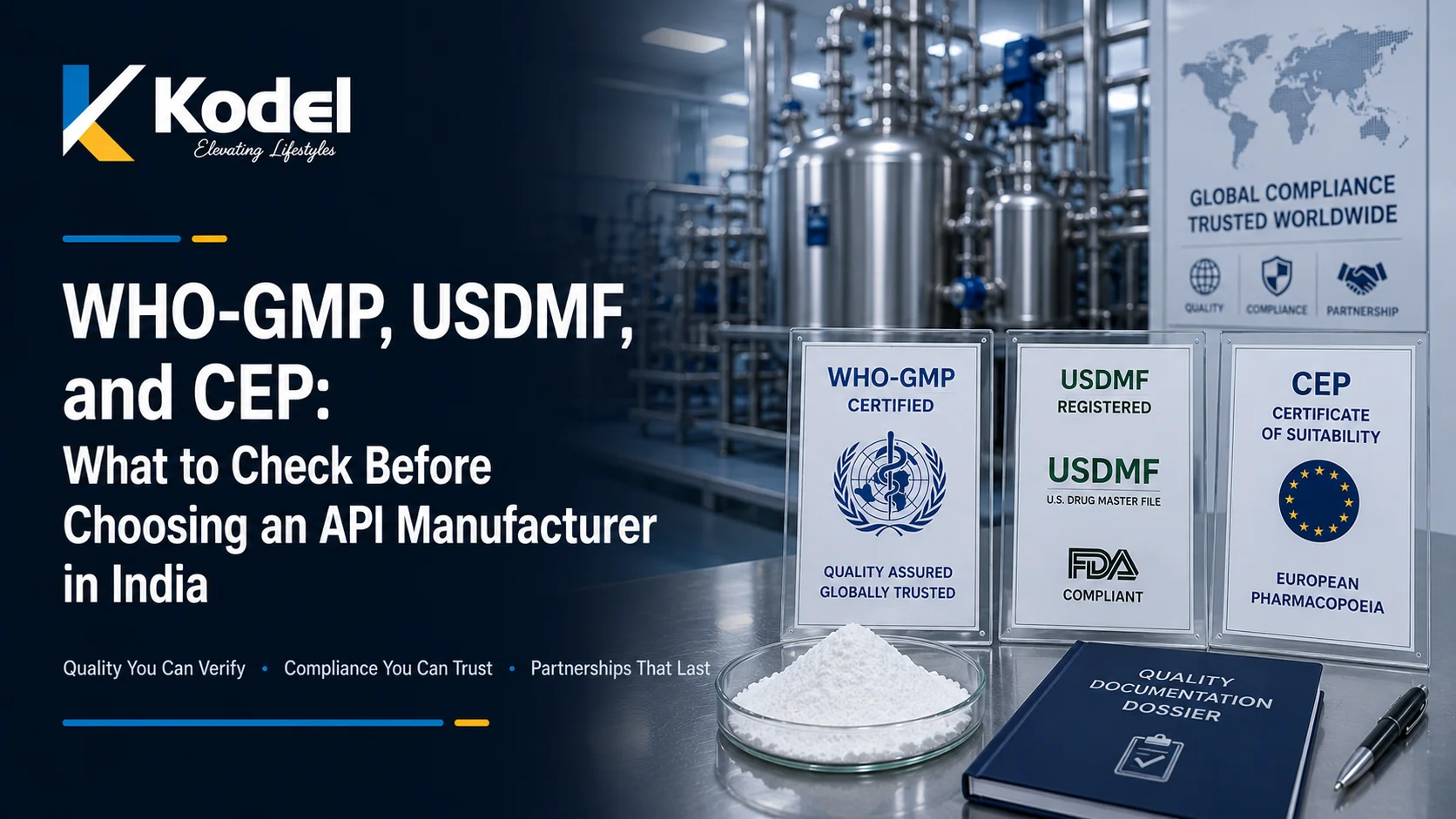
Three documents do most of the work in a supplier qualification file: the WHO-GMP certificate, the US Drug Master File, and the European Certificate of Suitability. Each answers a different regulatory question, and a formulator who understands what each one actually confirms can qualify an Indian API manufacturer faster and with fewer surprises during their own product's review.
What a WHO-GMP Certificate Actually Confirms
A WHO-GMP certificate is issued by a national regulatory authority, in India's case the Central Drugs Standard Control Organisation together with state licensing authorities, after an inspection confirms a manufacturing site meets the production and quality control standards set out in WHO Technical Report Series guidance. The certificate applies to a specific manufacturing site and product category, not to a company as a whole, so a formulator should confirm the certificate actually covers the API and manufacturing block being sourced from, not simply that the company holds a WHO-GMP certificate somewhere in its portfolio.
WHO-GMP certification is typically the minimum bar for exporting API into markets across Africa, Southeast Asia, and Latin America, and it also functions as a baseline credibility signal for buyers in more heavily regulated markets before deeper due diligence begins. It does not, on its own, confirm the site has passed a US FDA or EU inspection, which is why buyers targeting those markets need to look further.
The US Drug Master File: Type II Filings and What to Ask For
A Type II Drug Master File is the mechanism an API manufacturer uses to share confidential manufacturing and quality data with the US FDA without disclosing it directly to the formulator referencing it. The manufacturer files the DMF, receives a filing number, and the formulator's own abbreviated new drug application references that number, which lets the FDA cross-check the API data during its review of the finished product. A formulator sourcing metoprolol succinate or metoprolol tartrate API for a US-bound ANDA should confirm the DMF number is active and has not received a deficiency letter that remains unresolved.
Filing a DMF does not guarantee it will be reviewed favorably, since the FDA only evaluates a DMF's content in the context of a specific ANDA that references it. Buyers should ask the manufacturer how many ANDAs currently reference their DMF for the molecule in question, since a DMF with multiple successful references carries more practical assurance than one that has never been tested through an actual FDA review cycle.
The European Certificate of Suitability (CEP): When It Matters
A Certificate of Suitability, issued by the European Directorate for the Quality of Medicines, confirms that an API manufacturer's process and quality controls are suitable to meet the relevant European Pharmacopoeia monograph. It serves a similar function to a DMF but is specific to the EU regulatory framework, and unlike a DMF, the CEP itself is a public document that formulators can verify directly through the EDQM database rather than relying solely on the manufacturer's representation.
A CEP matters most for formulators filing into EU member states or other markets that accept CEPs as part of a simplified quality dossier. For a molecule like hydrochlorothiazide or piroxicam API, where the European Pharmacopoeia monograph is well established, a current CEP substantially shortens the quality section of a marketing authorisation application compared with submitting full manufacturing data independently.
Matching Documentation to Molecule: Furosemide, Metoprolol, Piroxicam, and Hydrochlorothiazide
Documentation depth varies by molecule maturity in a given manufacturer's portfolio. A well-established furosemide API manufacturer with years of export history typically holds an active DMF, a CEP, and multiple national GMP certificates, since the molecule has moved through many buyers' qualification processes already. A piroxicam API supplier serving a smaller, more specialised buyer base may hold WHO-GMP and a national GMP certificate without yet carrying a US DMF, which is not disqualifying but does mean the buyer should confirm what documentation timeline the manufacturer can commit to if a US filing is planned.
For metoprolol succinate and metoprolol tartrate API, request documentation specific to each salt form rather than assuming shared paperwork, since the two are filed and monographed separately. Hydrochlorothiazide API sourcing should include confirmation of compatibility data with the specific combination partners a formulator plans to use, since regulators increasingly expect combination-specific stability evidence rather than single-molecule data alone.
Site Inspection History: Reading Between the Certificates
A current certificate confirms a facility passed its most recent inspection, but it does not show the inspection history that led there. Ask for the manufacturer's most recent inspection observations, whether from CDSCO, WHO, USFDA, or an EU authority, and how the site closed out any findings. A site with a documented, closed-out corrective action history demonstrates a functioning quality system more convincingly than a certificate with no visible inspection record behind it.
Publicly available USFDA inspection classification data, when a site has been inspected by the agency, is a useful independent cross-check against what a manufacturer represents during supplier qualification. Buyers evaluating a metoprolol or hydrochlorothiazide API manufacturer with US FDA inspection history should review the agency's published classification for that site before relying solely on the manufacturer's own summary.
Building a Documentation Checklist Before You Issue an RFQ
| Document | Issuing Body | What It Confirms |
| WHO-GMP Certificate | National authority (CDSCO in India) | Site meets WHO Technical Report Series manufacturing standards |
| US DMF (Type II) | US FDA | Confidential manufacturing data available for ANDA cross-reference |
| CEP | EDQM | Process meets European Pharmacopoeia monograph requirements |
| Site Master File | Manufacturer, reviewed at inspection | Overview of facility, equipment, and quality systems |
| Stability Data (ICH zone) | Manufacturer | API stability under destination-market climatic conditions |
Request every document on this list before issuing a purchase order, not after. A manufacturer's willingness to share this documentation promptly during the RFQ stage is itself informative: a supplier confident in its regulatory position rarely hesitates to provide it.
Documentation Is the Cheapest Due Diligence You Will Do
Every hour spent verifying a WHO-GMP certificate, a DMF filing status, or a CEP reference before committing to a supplier costs far less than discovering a documentation gap after a regulatory agency raises it during review of the finished product. The manufacturers worth building a long-term cardiovascular or anti-inflammatory API supply relationship with are the ones that treat this documentation as readily available, not as something to produce only under pressure.
As more buyers diversify their API sourcing away from single-country dependence, the manufacturers that can produce a complete, current documentation package on request will absorb a growing share of that shifting demand.