


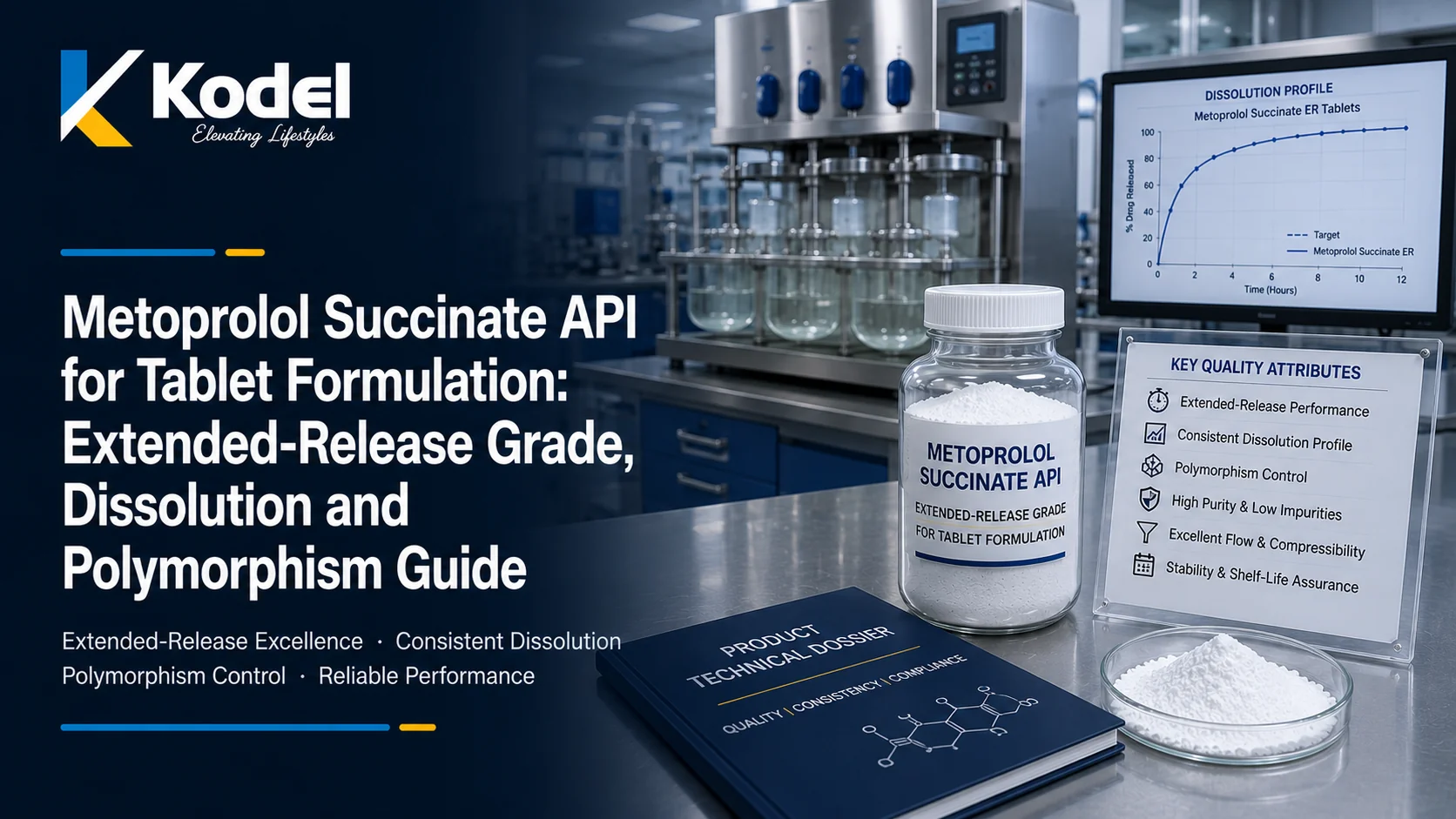
A formulation scientist developing a Metoprolol Succinate extended-release tablet faces a set of API-driven challenges that do not appear in the pharmacopoeial monograph. Assay compliance is necessary. It is not sufficient. The ER tablet must deliver metoprolol at a controlled, reproducible rate over 24 hours, meet USP dissolution specification for Metoprolol Succinate extended-release tablets across multiple pH stages, and maintain that dissolution profile across commercial batches manufactured from API lots sourced over months or years of production.
All three requirements are directly affected by physical properties of the Metoprolol Succinate API that vary across manufacturers and, in some cases, across production batches from the same manufacturer: particle size distribution, polymorphic form, bulk density, and moisture content. A formulation team that fully characterises the API's physical profile before initiating ER tablet development avoids the dissolution failures, scale-up surprises, and regulatory response cycles that follow from discovering API variability after the formulation has been locked.
This guide covers the technical considerations for formulation scientists working with Metoprolol Succinate API for ER tablet development: what physical specifications to request from your API supplier, how polymorphism affects dissolution, what the USP dissolution specification for Metoprolol Succinate ER tablets requires, and which excipient compatibility considerations are specific to this molecule.
Why Extended-Release Tablet Performance Is Uniquely API-Sensitive
Immediate-release tablets are forgiving of API physical property variation. A wider particle size range or moderate batch-to-batch variation in bulk density rarely causes a dissolution failure in a rapidly disintegrating IR formulation, because the dissolution driver is the tablet's disintegration and the solubility of the API rather than its surface area-to-volume ratio in a diffusion or erosion system.
Extended-release systems work differently. Whether the ER mechanism is a hydrophilic matrix (hydroxypropyl methylcellulose, HPMC), a lipid matrix, a membrane-controlled reservoir, or a multi-unit pellet system (MUPS), the rate of drug release depends on the interaction between the API's physical form and the release-controlling polymer or membrane. Particle size affects how uniformly the API is distributed within the matrix and how rapidly it dissolves once exposed to the release medium. Polymorphic form affects the solubility of the API at the matrix-medium interface, which directly determines the concentration gradient driving diffusion. Bulk density affects granulation behaviour and tablet press performance at scale.
This means that a Metoprolol Succinate ER tablet developed and optimised with API from one supplier can fail dissolution testing when transferred to API from a second supplier, even if both suppliers' COA results are fully within pharmacopoeial specification. The formulation is not broken. The API physical profile has changed, and the formulation has not been optimised for the new profile. This is a preventable problem, prevented by fully specifying the API's physical properties before formulation development begins and by qualifying any new API supplier against those specifications before switching.
Particle Size Distribution: The Formulation-Critical Specification
Particle size distribution is the single most formulation-critical physical property of Metoprolol Succinate API for ER tablet development. The USP monograph for Metoprolol Succinate does not specify a particle size requirement, because particle size is a formulation-specific parameter rather than a universal quality attribute. The responsibility for defining the particle size specification rests with the formulation scientist, and it must be established during early formulation development by empirically testing the impact of different particle size ranges on the ER dissolution profile.
D10, D50, D90: What Each Parameter Controls
Laser diffraction particle size analysis reports three key parameters: D10, the particle diameter below which 10 percent of the volume distribution falls; D50, the median particle diameter; and D90, the particle diameter below which 90 percent of the volume distribution falls. For Metoprolol Succinate ER formulation, the D90 value is typically the most formulation-critical parameter, because large particles in the tail of the distribution dissolve more slowly than the median, creating a drug release lag that can produce a slow dissolution profile in the early time points of a multi-stage USP dissolution test.
A D90 above 150 microns in a hydrophilic matrix ER system frequently produces a dissolution profile that is too slow in the first two to four hours, failing the lower acceptance criterion at the early time point of a multi-stage dissolution specification. A D90 below 50 microns can produce a dissolution profile that is too fast, as the API's high surface area accelerates dissolution relative to the matrix's release-controlling capacity. Most Metoprolol Succinate ER formulations require a D90 in the range of 60 to 120 microns, though the exact range is formulation and release system dependent and should be established empirically during development.
Communicating the Specification to Your API Supplier
Once the formulation team has established the required particle size range through development studies, the specification must be included in the API purchase specification and confirmed in the COA for every commercial batch. A Metoprolol Succinate API supplier who cannot provide D10, D50, and D90 data measured by laser diffraction as part of their standard batch testing, or who cannot supply material to a specified particle size range consistently across production batches, is not providing the physical specification control that ER tablet formulation and commercial manufacture require.
Kodel Life: We supplies Metoprolol Succinate API with particle size distribution data (D10, D50, D90 by laser diffraction) as part of the standard batch COA. Custom particle size ranges can be specified for ER formulation development orders. Particle size data across a minimum of three consecutive commercial batches is available on request to support formulation development and API specification setting.
Polymorphism in Metoprolol Succinate: Why Polymorph Identity Is a Batch Release Requirement
Metoprolol Succinate can exist in multiple polymorphic forms, each with a distinct crystal lattice structure, X-ray powder diffraction (XRPD) pattern, and differential scanning calorimetry (DSC) thermogram. The thermodynamically stable polymorph at ambient temperature and humidity is the commercially relevant form for ER tablet formulation. A different polymorph, or a mixture of polymorphs arising from variation in crystallisation conditions during API manufacturing, can alter the solubility of the API at the molecular level, which in turn affects the dissolution rate within the ER matrix.
The magnitude of the dissolution effect from a polymorph change varies with the ER system architecture. In a hydrophilic matrix, where dissolution at the matrix surface determines the local drug concentration gradient, a less soluble polymorph can reduce early-time-point drug release significantly. In a membrane-controlled reservoir system, where solubilisation within the core determines the driving force for permeation, a polymorph shift can alter the flux of metoprolol across the membrane in a way that no amount of formulation adjustment will correct without reformulation.
Formulation note: If a Metoprolol Succinate ER tablet batch fails dissolution testing without any apparent formulation or process change, the first analytical investigation should check the polymorph identity of the API used in that batch by XRPD, before investigating granulation or compression parameters. A polymorph shift at the API level is a root cause that process adjustments will not resolve.
How to Verify Polymorph Control in Your API Supplier
Ask any prospective Metoprolol Succinate API supplier three specific questions about polymorph control. First, is XRPD polymorph identification part of the standard batch release specification or only tested on request? A manufacturer who tests polymorph identity as part of every batch release provides systematic assurance that the crystallisation process is under control. Second, can they provide XRPD overlay plots showing batch-to-batch consistency across multiple production lots? Third, does their crystallisation process have validated parameters for the key variables affecting polymorph formation, including solvent composition, crystallisation temperature, cooling rate, and drying temperature?
A manufacturer who answers all three questions with documentary evidence rather than verbal assurances has the polymorph control process depth that ER tablet formulation supply chains require. A manufacturer who cannot confirm that XRPD is a batch release test represents a polymorph consistency risk that is impossible to manage through COA review alone.
USP Dissolution Specification for Metoprolol Succinate ER Tablets: What the Test Requires
The USP dissolution test for Metoprolol Succinate extended-release tablets uses a multi-stage, multi-time-point specification designed to evaluate the ER tablet's performance across the range of pH environments encountered in the gastrointestinal tract after oral administration. The test uses the USP Apparatus 2 (paddle) at 50 rpm, with sequential medium changes to simulate gastric and intestinal pH transitions.
| Time Point | Medium | Acceptance Criterion (Q) |
| 1 hour | 0.1 N HCl (pH 1.2) | NMT 30 percent dissolved |
| 4 hours | pH 6.8 phosphate buffer | 20 to 55 percent dissolved |
| 8 hours | pH 6.8 phosphate buffer | 45 to 80 percent dissolved |
| 16 hours | pH 6.8 phosphate buffer | NLT 80 percent dissolved |
The four-time-point specification creates four separate pass/fail checkpoints, any one of which can cause a batch failure. The early time point at one hour is the most API-sensitive: a formulation that releases more than 30 percent of the labelled dose in the first hour is not providing adequate gastric phase control, which typically indicates either a dissolution-rate issue from large API particles or a polymorph with higher-than-expected solubility at pH 1.2. The late time point at 16 hours is the formulation and manufacturing quality checkpoint: failure to release at least 80 percent of the dose by 16 hours indicates an ER system that is releasing drug too slowly, which can arise from over-extended matrix swelling, API particle size that is too large, or excess polymer levels in the granulation.
API Contribution to Dissolution Failure Risk
Of the dissolution failure scenarios in Metoprolol Succinate ER tablet manufacture, the API-attributable causes include: D90 particle size outside the validated range for the formulation, resulting in deviation at the early or late time points; polymorph shift producing a change in the intrinsic dissolution rate of the API; moisture uptake during storage affecting the API's physical form and granulation behaviour; and batch-to-batch variation in bulk density producing inconsistent granulation and tablet compression outcomes. All four causes are preventable through the combination of a tightly specified API physical profile and a supplier with validated process controls for each parameter.
Excipient Compatibility Considerations for Metoprolol Succinate ER Formulations
Metoprolol Succinate is a relatively stable molecule at ambient conditions, but formulation scientists should be aware of several excipient compatibility considerations that are specific to the succinate salt and the ER tablet architecture before finalising the formulation composition.
Hygroscopic Behaviour and Moisture Management
Metoprolol Succinate is moderately hygroscopic. At elevated relative humidity, particularly above 75 percent RH, the API can absorb sufficient moisture to affect its flow properties and granulation behaviour. In a hydrophilic matrix ER formulation, excess moisture in the API feed can alter the initial viscosity development of the HPMC matrix upon hydration, producing a faster-than-expected early dissolution rate. Granulation processes that use aqueous granulation fluid with Metoprolol Succinate require careful control of inlet air humidity and drying endpoint to prevent moisture-driven dissolution variability.
Interaction With Anionic Excipients
Metoprolol Succinate is a cationic salt. It can interact with anionic excipients through ionic interaction, which can affect the drug release rate in matrix systems. Sodium lauryl sulphate, commonly used as a wetting agent in tablet granulations, has been reported to interact with metoprolol in some formulation contexts. Formulators using anionic surfactants or disintegrants in Metoprolol Succinate ER systems should conduct forced degradation compatibility studies early in development to confirm the combination does not produce degradation products or alter the in-vitro dissolution profile.
HPMC Grade Selection for Matrix Control
The most common ER matrix polymer for Metoprolol Succinate tablets is hydroxypropyl methylcellulose (HPMC), typically in viscosity grades from HPMC K4M to HPMC K15M depending on the required release rate and tablet dimensions. The HPMC grade selection interacts directly with the API particle size: a formulation using HPMC K4M with a D90 of 80 microns will produce a faster dissolution profile than the same system with HPMC K15M, even with identical API loading and tablet geometry. Particle size and polymer grade should be optimised simultaneously rather than sequentially during formulation development.
See also: For full physical and pharmacopoeial specification details for Metoprolol Succinate API, see the pillar guide: Metoprolol Succinate API Complete Guide
Technical Data to Request From Your Metoprolol Succinate API Supplier Before Formulation
Formulation scientists initiating Metoprolol Succinate ER tablet development should request a standard set of technical data from any API supplier before placing even a development-scale order. The data request covers analytical characterisation, process consistency evidence, and regulatory support documentation.
Analytical Characterisation Package
Request the following data for a recent commercial batch: COA to the applicable pharmacopoeial grade (IP, BP, USP, or EP) with all numeric results including assay, related substances, water content, and residue on ignition; particle size distribution report (D10, D50, D90 by laser diffraction); XRPD diffractogram confirming polymorph identity; DSC thermogram; bulk density and tapped density with Carr's index; and intrinsic dissolution rate data if available. A supplier who can provide all elements of this package from a standard commercial batch COA and supporting analytical report is operating at the technical documentation depth that ER formulation development requires.
Process Consistency Evidence
Request particle size data, XRPD results, and assay results across a minimum of three consecutive commercial production batches. Batch-to-batch consistency across these parameters, rather than compliance in a single batch, is the evidence that the supplier's process is under sufficient control to support ER formulation development where the formulation will be optimised against a defined API physical profile.
Stability Data Summary
Request the ICH Q1A stability data summary for Metoprolol Succinate API, covering long-term (25 degrees Celsius / 60 percent RH) and accelerated (40 degrees Celsius / 75 percent RH) conditions for a minimum of 12 months. Confirm that the stability data covers the specific pharmacopoeial grade you intend to purchase and that the re-test period is supported by actual batch data rather than extrapolation.
Kodel Life provides a complete technical data package for Metoprolol Succinate API on request for qualified formulation development enquiries. The package includes COA with all pharmacopoeial and physical parameters, XRPD polymorph confirmation, particle size distribution data across three consecutive batches, DSC thermogram, Carr's index, and ICH Q1A stability data summary. Technical data sheet requests are processed within one to two business days.
Specify the API the Formulation Needs, Not the API the Monograph Describes
The USP monograph for Metoprolol Succinate describes the chemical purity of the API. It does not describe the physical profile that a Metoprolol Succinate ER tablet formulation requires. Particle size distribution, polymorph identity, bulk density, and moisture content are the parameters that determine whether a Metoprolol Succinate ER tablet will pass dissolution testing at development scale, maintain that dissolution profile at commercial scale, and deliver consistent performance across batches manufactured from API sourced over a multi-year commercial supply relationship.
Formulation scientists who define the API physical specification before development begins, communicate that specification to their API supplier as a controlled purchase requirement, and qualify only suppliers, including Kodel Life, who provide the analytical evidence that their process delivers that specification consistently, build a formulation development programme on a foundation that holds at commercial scale.
The alternative is discovering at scale-up that the API lot used in development was atypical, and that the commercial batches your production line will receive have a particle size distribution, polymorph profile, or moisture content that your formulation was never optimised for.