


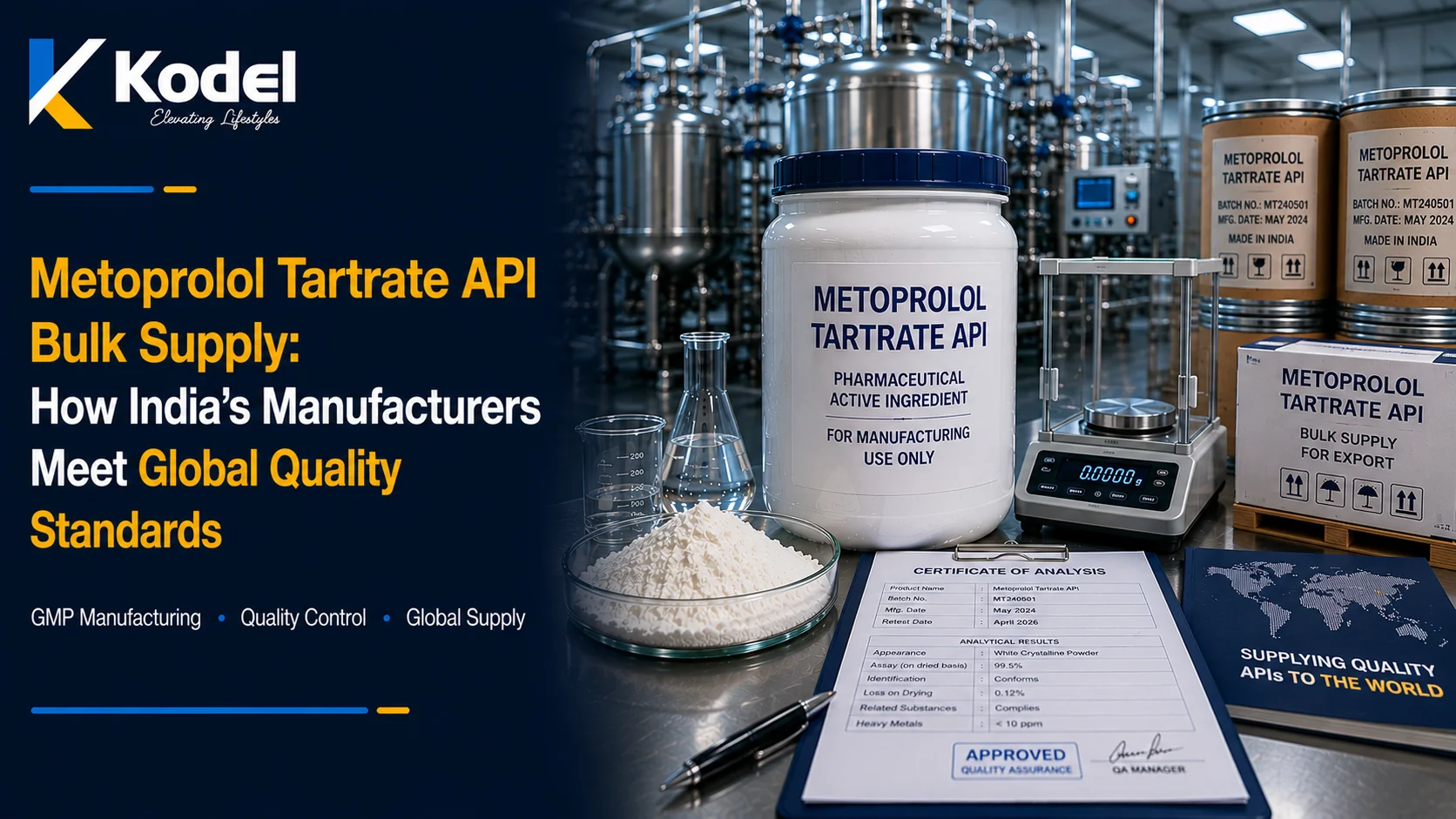
India supplies Metoprolol Tartrate API in commercial bulk volumes to pharmaceutical manufacturers in over 40 countries. The country's API manufacturing infrastructure for this molecule is mature, with established synthesis routes, validated analytical methods, and regulatory documentation frameworks that have supported decades of global supply. What varies significantly across Indian manufacturers, and what determines the real quality of a bulk Metoprolol Tartrate API supply relationship, is not whether GMP documentation exists but how deeply the quality system penetrates the day-to-day manufacturing operation.
This guide examines the quality systems that underpin Metoprolol Tartrate API bulk supply from India: the in-process controls that catch quality deviations before a batch is completed, the batch release testing programme that determines what appears on the COA, the ICH Q3A impurity control framework that protects finished-dose manufacturers from regulatory queries, and the supply continuity practices that prevent the batch quality and scheduling disruptions that are expensive to recover from in a commercial pharmaceutical supply chain.
In-Process Controls: Where Quality Is Built, Not Tested In
The phrase 'quality cannot be tested into a product' is a foundational principle of pharmaceutical manufacturing, established in ICH Q8 and reinforced in every major regulatory guidance document from FDA to EMA. For Metoprolol Tartrate API bulk manufacturing, this principle means that the quality of the finished API is determined primarily by the in-process control programme operating at defined checkpoints during the synthesis, not by the final COA test result. A batch that passes all final COA tests but was manufactured without adequate in-process control is not demonstrably consistent with its validated process.
The in-process control checkpoints for Metoprolol Tartrate API synthesis cover four principal stages. At the free base synthesis stage, in-process controls include pH monitoring during the ring-opening aminolysis reaction, temperature logging throughout the exothermic alkylation step, and HPLC assay of the crude metoprolol free base intermediate before proceeding to salt formation. At the recrystallisation stage, controls include solvent purity verification, monitoring of dissolved solids concentration in the recrystallisation medium, and particle size measurement of the purified free base intermediate. At the tartrate salt formation stage, controls include molar ratio verification of metoprolol free base to L-tartaric acid, pH of the salt formation reaction, and crystallisation temperature profile logging. At the drying stage, controls include inlet air temperature, product bed temperature, and moisture content by in-process Karl Fischer at defined time intervals to determine drying endpoint.
A buyer evaluating a Metoprolol Tartrate API bulk supplier's quality system should ask specifically whether these four stages have defined IPC checkpoints documented in the batch manufacturing record (BMR), whether IPC results are reviewed as part of the batch disposition decision, and whether any IPC excursion triggers an investigation before the batch proceeds to the next synthetic step. A manufacturer who conducts in-process sampling but does not review IPC results as part of batch disposition is not using IPC as a quality control tool; it is collecting data without acting on it.
Buyers who want to understand the full specification requirements for Metoprolol Tartrate API alongside the quality system context described in this article can find the complete manufacturing and specification guide, including USP versus BP pharmacopoeial comparison tables and regulatory documentation requirements, on the Metoprolol Tartrate API.
Batch Release Testing: What the COA Must Include and Why
The Certificate of Analysis is the document that summarises the analytical testing performed on a completed batch of Metoprolol Tartrate API before it is released for sale. The COA is the primary quality document the buyer receives and reviews. Understanding what a complete and compliant Metoprolol Tartrate API COA should include, and recognising what a deficient COA omits, is a practical quality assurance skill for any procurement team.
A complete Metoprolol Tartrate API COA issued by a cGMP manufacturer includes the batch number, manufacturing date, re-test date, and storage condition statement; the applicable pharmacopoeial standard reference (USP 47, BP 2024, or Ph. Eur. 11.0 with edition number); and numeric results for all compendial parameters. The compendial parameters for Metoprolol Tartrate include description, identification by IR and HPLC, assay (numeric percentage, not 'complies'), related substances (individual impurity percentages by HPLC, not 'ND' without detection limit), optical rotation (numeric result in degrees, 5 percent w/v solution), water content by Karl Fischer (numeric percentage), residue on ignition (numeric percentage), and heavy metals. For in-house specifications not in the pharmacopoeial monograph, such as particle size distribution, the COA should also include D10, D50, and D90 values if particle size is a controlled parameter in the buyer's API specification.
The Optical Rotation Entry: A Tartrate-Specific COA Requirement
The optical rotation result is specific to Metoprolol Tartrate and does not appear on Metoprolol Succinate COAs. It verifies that the tartaric acid used in salt formation was the L-enantiomer, producing a salt with the pharmacopoeially specified positive optical rotation. A COA that omits the optical rotation result is missing a mandatory pharmacopoeial parameter. Ask any supplier whose COA does not include a numeric optical rotation result whether they test optical rotation at the raw material stage (L-tartaric acid specification) or at the finished API stage. If neither is confirmed, the supplier is not controlling the enantiomeric purity of their tartaric acid source.
ICH Q3A Impurity Control in Metoprolol Tartrate API Bulk Manufacturing
ICH Q3A (Impurities in New Drug Substances) requires pharmaceutical API manufacturers to identify, qualify, and control impurities in their drug substance above defined thresholds. For Metoprolol Tartrate API, the impurity control programme must address two categories of impurities: process-related impurities arising from the synthesis route, and degradation impurities that can form during storage of the finished API.
The process-related impurities in Metoprolol Tartrate API arise from the same free base synthesis route as the succinate salt, including the di-isopropylamine adduct from the aminolysis step, glycidyl ether carryover from the epoxidation intermediate, and para-methoxyphenol residual from starting material carryover. The ICH Q3A thresholds, identification requirements, and qualification data obligations that apply to these impurities are identical for both salt forms. Buyers who want a detailed walkthrough of the ICH Q3A framework as applied to metoprolol API synthesis, including the impurity identification and qualification threshold table and the ICH M7 genotoxic impurity assessment for the glycidyl ether epoxide intermediate, will find the full treatment in the guide to Metoprolol Succinate API cGMP process chemistry and ICH Q3A impurity control.
The tartrate-specific degradation impurity risk arises from the hydroxyl groups on the L-tartaric acid counter-ion, which are susceptible to oxidative degradation under elevated temperature and humidity. Tartrate oxidation products, if they accumulate during API storage, can affect the optical rotation of the salt and, in extreme cases, the assay result. A properly designed stability programme with temperature and humidity controls, and storage in sealed moisture-protective packaging, prevents tartrate-specific degradation impurity accumulation across the re-test period.
Quality Parameters Buyers Should Verify Before Each Commercial Batch
For commercial bulk Metoprolol Tartrate API supply, the QA team at the buyer's finished-dose facility should apply a consistent COA review protocol to every incoming batch before initiating goods receipt acceptance. The review protocol covers six quality parameters that are most predictive of batch-to-batch consistency and finished-dose performance.
The five-parameter quality framework for metoprolol API COA review - assay numeric value, polymorph identity, particle size distribution, ICH Q3A impurity profile naming, and ICH Q1A stability data depth, is described in detail for the succinate salt in the Metoprolol Succinate API quality parameters checklist. For Metoprolol Tartrate, the same five parameters apply with one addition: optical rotation, which is a mandatory pharmacopoeial test for the tartrate salt and is absent from the succinate specification.
| Parameter | Acceptable Result | Red Flag | Tartrate-Specific? |
| Assay | Numeric %; 99.0-101.0 (BP) or 98.0-102.0 (USP) | 'Complies' without % value | No |
| Optical Rotation | Numeric degrees; +14.5 to +16.5 (5% w/v, USP) | Missing from COA | YES — tartrate only |
| Related Substances | Named impurities with numeric HPLC % | 'ND' without detection limit | No |
| Water Content (KF) | Numeric %; NMT 0.5% | 'Complies' without value | No |
| Particle Size (if controlled) | D10, D50, D90 by laser diffraction | Bulk density only; no PSD data | No |
| Re-test Date | Minimum 18 months from delivery | Already within 12 months of expiry | No |
Supply Continuity Practices: Managing Risk in Metoprolol Tartrate API Procurement
Single-Source vs Dual-Source Strategy
Metoprolol Tartrate API procurement from a single Indian supplier creates supply concentration risk across three disruption scenarios: raw material supply disruption (para-methoxyphenol, a key starting material for the free base synthesis, is sourced primarily from China), regulatory disruption (an FDA import alert or EU-GMP suspension can remove a facility from the approved supply pool without notice), and logistics disruption (monsoon-related port congestion at Indian ports, particularly in June to September, can delay API shipments by one to three weeks). Buyers with annual Metoprolol Tartrate API requirements above 500 kg should maintain a dual-qualified supplier relationship, with the primary supplier receiving the majority of order volume and the secondary supplier receiving periodic bridging orders to maintain their qualified status.
Lead Time Management
Standard lead times for commercial Metoprolol Tartrate API orders from qualified Indian suppliers are three to five weeks from confirmed purchase order for molecules with established batch scheduling. First-order lead times, including documentation review and sample testing, extend to eight to twelve weeks. Buyers who plan API procurement on a just-in-time basis without safety stock should be aware that any quality event requiring batch reinvestigation, or any shipping delay at origin or destination ports, can create a finished-dose manufacturing gap. Maintaining a minimum of six to eight weeks of safety stock for Metoprolol Tartrate API reduces the exposure to routine supply variability.
Annual Volume Commitment Benefits
Buyers with predictable annual volume requirements above 1,000 kg per year of Metoprolol Tartrate API can often negotiate annual volume commitment agreements with their primary Indian supplier that secure dedicated batch scheduling, priority raw material procurement, and fixed pricing for the commitment period. Annual commitments reduce lead time variability, because the supplier can pre-schedule synthesis batches in advance of the buyer's purchase orders rather than scheduling on a reactive basis. For high-volume buyers, the supply continuity value of a commitment agreement often exceeds the pricing benefit.
Stability Programme: Supporting the 24 to 36 Month Re-Test Claim
Metoprolol Tartrate API has a re-test period of 24 to 36 months under ICH Q1A recommended storage conditions (at or below 25 degrees Celsius, protected from moisture and light). This re-test period is only regulatory-grade when it is supported by actual stability data from commercial-scale batches conducted under ICH Q1A conditions, with numeric test results at each time point for all COA parameters including optical rotation, assay, related substances, and water content.
Stability data extrapolation from accelerated conditions (40 degrees Celsius / 75 percent RH) to real-time long-term conditions (25 degrees Celsius / 60 percent RH) is accepted by FDA and EMA reviewers as a provisional claim at product approval, but must be supported by ongoing real-time data that confirms the extrapolation is accurate. Buyers requesting stability data summaries from their Metoprolol Tartrate API supplier should ask for the actual numeric results at each ICH Q1A time point, not a conclusion statement. A supplier who can provide a complete stability data table with results at 0, 3, 6, 9, 12, 18, and 24 months under both storage conditions, from commercial-scale batches, is providing regulatory-grade stability documentation. A supplier who provides a one-page summary stating that the API is stable for 36 months without supporting data is not.
Kodel Life maintains a full ICH Q1A stability programme for Metoprolol Tartrate API covering long-term (25 degrees Celsius / 60 percent RH) and accelerated (40 degrees Celsius / 75 percent RH) conditions for each pharmacopoeial grade. Stability data summaries with numeric results at each time point are provided as standard regulatory support documentation for qualified buyers. The 62 MT per month production capacity with dedicated synthesis infrastructure ensures batch scheduling priority and supply continuity for commercial volume commitments.
Quality in Bulk Supply Is a System, Not a Certificate
A GMP certificate on the wall and a COA on the shipment are necessary conditions for pharmaceutical API supply. They are not sufficient conditions for quality in bulk supply. The quality of a Metoprolol Tartrate API bulk supply relationship is determined by whether the in-process controls are genuine, whether the impurity profile documentation is current and complete, whether the stability programme covers commercial-scale batches with real time points, and whether the supplier's response to quality events is transparent, fast, and technically rigorous.
These are the system-level quality attributes that Kodel Life has built into the Metoprolol Tartrate API manufacturing operation at Morbi, Gujarat: validated IPC at every critical process stage, named ICH Q3A impurity profiles with qualification data, a full ICH Q1A stability programme with commercial-scale batch data, and a technical team that responds to buyer enquiries within one to two business days. Contact info@kodellife.com or call +91 75023 33335 to discuss a bulk supply arrangement.
Request Bulk Pricing for Metoprolol Tartrate API: Contact Kodel Life for bulk pricing, annual volume commitment terms, COA from a recent commercial batch, and stability data summary. Email info@kodellife.com or call +91 75023 33335. Response within one to two business days.