


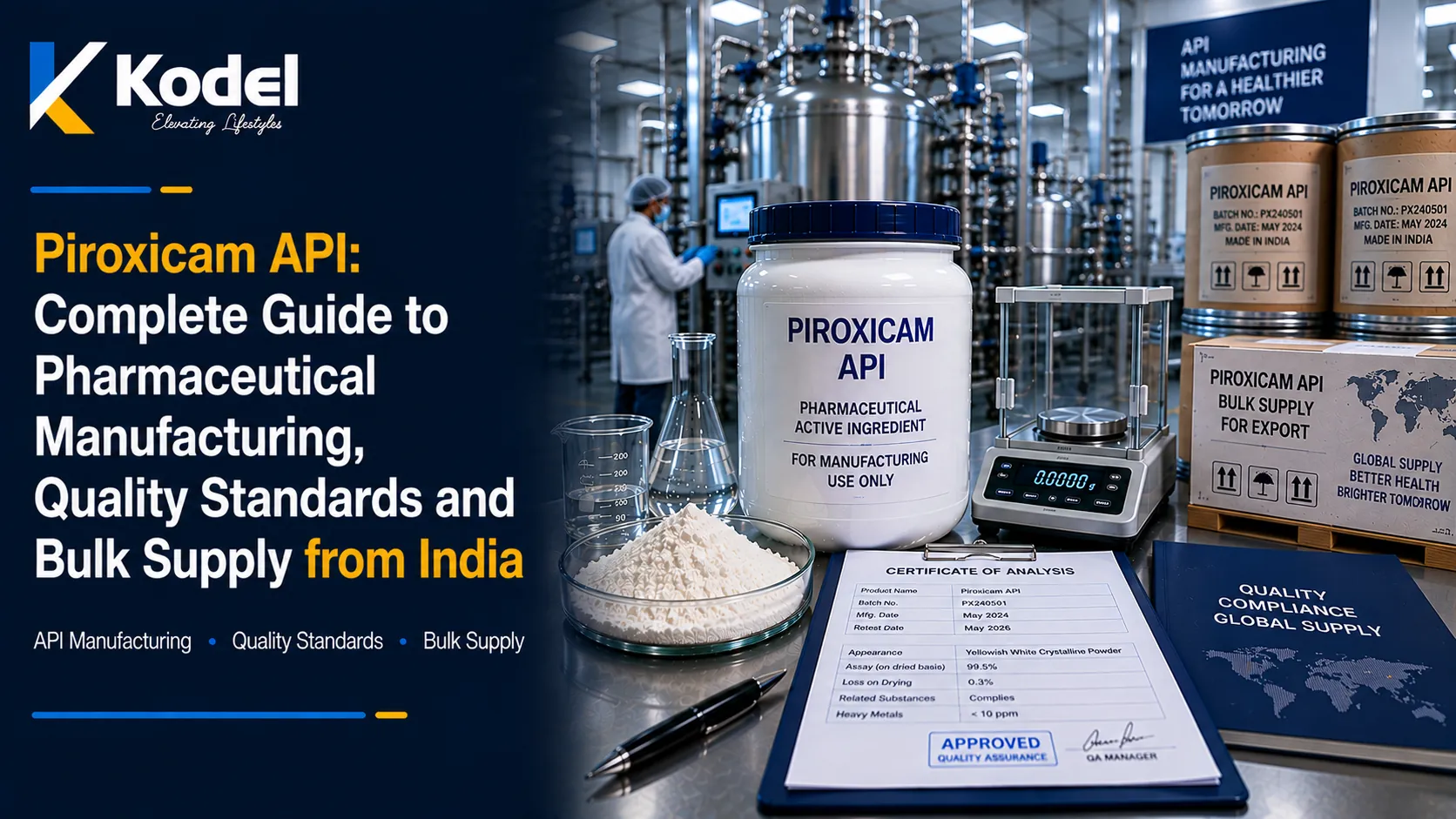
Piroxicam remains one of the most clinically and commercially significant non-steroidal anti-inflammatory drugs (NSAIDs) in the global pharmaceutical market four decades after its introduction. Its once-daily dosing profile, driven by a plasma half-life of 30 to 86 hours, makes it one of the longest-acting NSAIDs available in oral solid dosage forms. The global NSAID market was valued at approximately 15.5 billion US dollars in 2024 and continues to grow at a compound annual rate of approximately 4.1 percent, with Piroxicam maintaining a stable position in semi-regulated and emerging markets where once-daily NSAID therapy has cost and patient compliance advantages over shorter-acting alternatives.
For pharmaceutical manufacturers producing Piroxicam-containing finished-dose products, API sourcing from India represents the most cost-effective path to pharmacopoeial-grade material with the regulatory documentation depth required for international market registration. India's API manufacturing infrastructure for Piroxicam is well-established, with a synthesis route that is mature, multiple manufacturers operating at commercial scale, and a regulatory certification landscape that spans WHO-GMP, EU-GMP, and FDA-compliant facilities.
This guide covers everything a pharmaceutical buyer, regulatory affairs professional, or formulation scientist needs to know before sourcing Piroxicam API: the chemistry and polymorphic forms that affect formulation performance, the pharmacopoeial quality standards for BP and USP compliance, the cGMP manufacturing controls that predict supply consistency, and the regulatory documentation package required for ANDA and MA filings.
What Is Piroxicam API: Chemistry, Pharmacology and Clinical Position
Piroxicam (CAS 36322-90-4, IUPAC name: 4-hydroxy-2-methyl-N-(2-pyridyl)-2H-1,2-benzothiazine-3-carboxamide 1,1-dioxide, molecular formula C15H13N3O4S, molecular weight 331.3 g/mol) is a member of the oxicam class of NSAIDs. It acts through non-selective inhibition of cyclo-oxygenase enzymes COX-1 and COX-2, reducing prostaglandin synthesis and producing analgesic, anti-inflammatory, and antipyretic effects. Its clinical applications include rheumatoid arthritis, osteoarthritis, ankylosing spondylitis, acute musculoskeletal disorders, and dysmenorrhoea.
The pharmacokinetic profile that distinguishes Piroxicam from most other NSAIDs is its unusually long plasma half-life of 30 to 86 hours, which enables once-daily oral dosing at 10 mg to 20 mg. This half-life arises from extensive plasma protein binding (approximately 99 percent), low renal clearance, and enterohepatic recirculation. Once-daily dosing improves patient adherence in chronic inflammatory conditions such as rheumatoid arthritis, where long-term consistent NSAID therapy is required to manage joint inflammation and pain. The therapeutic index limitation of Piroxicam relative to some newer selective COX-2 inhibitors is its gastrointestinal risk profile at higher doses, which is managed clinically through dose optimisation and gastroprotective co-therapy.
Global demand for Piroxicam API remains concentrated in semi-regulated markets across South Asia, Southeast Asia, Latin America, Sub-Saharan Africa, and the Middle East, where the molecule's cost-effectiveness and once-daily convenience drive high finished-dose volumes. Regulated market demand, while smaller in absolute volume, requires higher documentation depth and pharmacopoeial compliance precision from API suppliers.
Polymorphic Forms of Piroxicam API: The Most Formulation-Critical Property
Piroxicam is one of the most extensively studied polymorphic pharmaceutical molecules in the scientific literature. It exists in at least three well-characterised polymorphic forms and several solvate/hydrate forms, each with distinct X-ray powder diffraction (XRPD) patterns, differential scanning calorimetry (DSC) profiles, and dissolution rates. The polymorphic form of the API directly affects the dissolution rate of Piroxicam finished-dose formulations, and polymorphic inconsistency across commercial API batches is the most common root cause of dissolution failures in Piroxicam tablet and capsule production.
Form I: The Thermodynamically Stable Polymorph
Piroxicam Form I is the thermodynamically stable polymorph at ambient temperature and is the commercially standard form used in most Piroxicam tablet and capsule formulations. It is characterised by a melting point of approximately 198 to 200 degrees Celsius, a specific XRPD diffractogram with characteristic peaks at defined 2-theta angles, and a DSC endotherm at the same melting point range. The USP and BP monographs for Piroxicam do not specify a particular polymorphic form, but the reference standard from which pharmacopoeial dissolution specifications are derived is based on Form I material. Formulations developed with Form I API must be validated and registered using Form I, and commercial supply must maintain Form I consistency across batches.
Form II and Form III: Metastable Polymorphs
Piroxicam Form II and Form III are metastable polymorphs that can form during crystallisation under different solvent, temperature, or cooling rate conditions than those used to produce Form I. Both metastable forms have higher apparent solubility and faster initial dissolution rates than Form I, which might appear advantageous for formulation but is problematic in practice because metastable forms can convert to the more stable Form I during storage, particularly under elevated temperature or humidity conditions. This solid-state conversion during product shelf life produces a dissolution rate decrease over time, which can cause marketed products to fail their dissolution specification at accelerated stability time points even when the product passed at release.
A cGMP Piroxicam API manufacturer controls polymorph identity as a batch release specification using XRPD and DSC, validates their crystallisation process to consistently produce Form I, and monitors polymorph identity across the API's re-test period as part of their stability programme. Buyers must confirm that their supplier tests polymorph identity on every batch release — not on request, and not only during process validation — before committing to commercial supply.
Formulation note: Never assume polymorph identity from the melting point alone. Piroxicam Form I and Form II have different melting points (approximately 198-200 degrees Celsius for Form I versus approximately 165-168 degrees Celsius for Form II), but DSC alone cannot distinguish all polymorphic forms reliably. XRPD is the definitive polymorph identification technique for Piroxicam API and must be the batch release test standard.
Pharmacopoeial Quality Standards: BP and USP Specifications
Piroxicam API is described in the British Pharmacopoeia (BP), United States Pharmacopeia (USP), European Pharmacopoeia (Ph. Eur.), and Indian Pharmacopoeia (IP). The BP and Ph. Eur. monographs share a common specification as part of the European Pharmacopoeia harmonisation programme. The USP and BP/Ph. Eur. monographs differ in assay limits and impurity thresholds, with the BP/Ph. Eur. applying a tighter assay range.
| Specification Parameter | USP Requirement | BP / Ph. Eur. Requirement |
| Assay (dried basis) | 98.0% to 102.0% | 99.0% to 101.0% |
| Appearance | Yellow powder or crystals | Yellow or light yellow crystalline powder |
| Related Substances (single) | NMT 0.2% | NMT 0.10% (specified impurities) |
| Loss on Drying | NMT 0.5% | NMT 0.5% |
| Residue on Ignition | NMT 0.1% | NMT 0.1% |
| Heavy Metals | NMT 20 ppm | Complies Ph. Eur. 2.4.8 |
| Melting Point (Form I) | 198 to 202 degrees Celsius | 198 to 200 degrees Celsius |
| Residual Solvents | Per ICH Q3C | Per ICH Q3C / Ph. Eur. 2.4.24 |
The melting point specification in both monographs is a practical proxy for polymorph identity in routine batch testing: a Piroxicam batch whose melting point falls in the 198 to 202 degree Celsius range is consistent with Form I. A batch with a melting point below 190 degrees Celsius is likely a metastable polymorph or a mixed-polymorph batch. However, the melting point alone is not a definitive polymorph identification test and should be supplemented with XRPD as a batch release specification for any supplier serving regulated markets.
Kodel Life supplies Piroxicam API to IP, BP, USP, and Ph. Eur. pharmacopoeial grades from the Morbi, Gujarat facility. Full specification data including XRPD polymorph confirmation, particle size distribution, and ICH Q1A stability data for each pharmacopoeial grade are available on request. Visit the Piroxicam API product page for specification overview and bulk pricing enquiry.
Piroxicam API Manufacturing: Synthesis Route and cGMP Controls
Piroxicam is synthesised through a multi-step route starting from saccharin (1,2-benzisothiazolin-3-one 1,1-dioxide), which serves as the sulfonamide ring precursor. The principal synthetic steps involve ring opening of saccharin under basic conditions to form the benzothiazine intermediate, N-methylation to introduce the methyl group at position 2, condensation with ethyl oxalyl chloride to form the 3-carboxylate ester intermediate, and final condensation with 2-aminopyridine to form the Piroxicam amide bond. The synthesis is completed by ring closure and cyclisation steps that establish the oxicam scaffold, followed by purification by recrystallisation from a suitable solvent system.
Under ICH Q7, the cGMP framework for API manufacturing, the manufacturer must define the starting material for the synthesis, validate the process with documented critical process parameters at each synthetic step, and maintain batch manufacturing records that capture every parameter for every commercial batch. For Piroxicam, the critical process parameters at the recrystallisation stage are the most formulation-consequential: the solvent system composition, crystallisation temperature, cooling rate, and anti-solvent addition profile collectively determine which polymorphic form crystallises and the particle size distribution of the final API.
A validated Piroxicam API manufacturing process includes XRPD monitoring of the recrystallisation output as an in-process control step, not just as a final release test. If the in-process XRPD confirms the wrong polymorph is forming before the crystallisation step is complete, the batch can be re-slurried and recrystallised under corrected conditions. Once the batch has been dried and the wrong polymorph is confirmed at final release testing, recovery options are limited and the batch is typically rejected.
ICH Q3A Impurity Profile for Piroxicam API
Piroxicam API synthesis produces a characteristic set of process-related impurities arising from the multi-step organic synthesis route. Under ICH Q3A, the manufacturer must identify impurities above the 0.10 percent identification threshold, qualify those above the 0.15 percent qualification threshold, and control all impurities within the pharmacopoeial specification limits. The principal named impurities in the Piroxicam ICH Q3A profile include saccharin (the starting material), the methylated saccharin intermediate (N-methylsaccharin), the oxalyl chloride condensation by-product, 2-aminopyridine (the amine component), and Piroxicam-related substances arising from incomplete cyclisation or partial degradation during synthesis.
A cGMP Piroxicam API manufacturer provides a fully named ICH Q3A impurity profile covering each identified impurity above the reporting threshold, with individual HPLC limits, qualification status, and an ICH M7 genotoxic impurity risk assessment for any impurity carrying a structural alert. The saccharin starting material requires specific attention in the ICH M7 assessment: saccharin was previously listed as a possible human carcinogen by IARC, though this classification has since been revised. However, the ICH M7 assessment for a specific manufacturer's process must address the fate and purge of saccharin residuals through the synthesis steps to the final API.
For buyers preparing or reviewing a Piroxicam API drug substance section for an ANDA or EU MA dossier, understanding how ICH Q3A impurity qualification requirements interact with DMF and CEP filing obligations is essential for structuring the regulatory support request to their API supplier. The detailed framework covering how WHO-GMP, DMF, and CEP certifications integrate with ICH Q3A impurity documentation obligations for Indian API manufacturers is covered in the guide to WHO-GMP, DMF and CEP compliance for Indian API manufacturers.
Regulatory Documentation for Piroxicam API: DMF, CEP and Export Compliance
US Market: FDA Drug Master File
A Type II Drug Master File for Piroxicam API is required for any Indian manufacturer supporting a US ANDA filing for a Piroxicam-containing finished-dose product. The DMF covers the full synthesis route from the defined starting material, impurity qualification data per ICH Q3A, ICH M7 genotoxic impurity assessment, analytical method validation data, and ICH Q1A stability data for the API. The ANDA filer references the DMF number in their application; FDA reviews the DMF alongside the ANDA. Verify any supplier's DMF status on the FDA public database at accessdata.fda.gov before including them as a drug substance source in an ANDA filing.
EU Market: EDQM Certificate of Suitability
For EU MA filings, an EDQM Certificate of Suitability (CEP) for Piroxicam API from the Indian manufacturer simplifies the Module 3 drug substance section significantly. The CEP reference replaces the full drug substance manufacturing description in the MA dossier and confirms that EDQM has independently reviewed and verified the manufacturing process. Verify CEP status on the EDQM public database. Where a CEP is not available, the MA holder must include the full drug substance section with the Indian manufacturer's process description, impurity qualification data, and analytical methods, supported by a Qualified Person declaration for each batch released for EU finished-dose production.
Export Documentation Pack
A complete Piroxicam API export documentation pack from a qualified Indian manufacturer includes the batch COA referencing the applicable pharmacopoeial standard with all numeric results, a GMP certificate applicable to the destination market authority, a GHS-compliant Material Safety Data Sheet with CAS number 36322-90-4, a Certificate of Country of Origin, HS code classification documentation (HS code 2942.00 for Piroxicam API as an other organic compound), and for US-bound shipments, a DEA controlled substance exemption statement confirming Piroxicam is not scheduled under the US Controlled Substances Act.
Piroxicam API Physical Specifications for Formulation
Particle Size Distribution
Piroxicam's low aqueous solubility (approximately 0.007 mg/mL at 25 degrees Celsius, pH 7.4) makes particle size distribution a critical physical specification for oral solid dosage form dissolution performance. Smaller particle size increases specific surface area and dissolution rate, which is particularly important for Piroxicam tablets where the API's inherent low solubility can limit the dissolution rate to below the USP specification acceptance criterion if the API particle size is too large. Most Piroxicam tablet and capsule formulations require a D90 below 100 microns, with formulations targeting faster dissolution profiles requiring D90 below 50 microns. Buyers should confirm D10, D50, and D90 by laser diffraction with their API supplier and include particle size as a controlled parameter in their API purchase specification.
Bulk Density and Flow
Piroxicam API is a low-density powder with Carr's index values that vary with the crystallisation conditions used in manufacturing. The powder flow characteristics affect granulation behaviour and tablet press performance, particularly at the low API loadings typical of 10 mg and 20 mg Piroxicam tablet formulations where the API represents 5 to 10 percent of the tablet weight. Suppliers who report bulk density, tapped density, and Carr's index as part of their standard COA provide formulation teams with the physical property data needed to maintain granulation process consistency across API batches from different production lots.
Colour and Appearance
Piroxicam API is a yellow to light yellow crystalline powder under both USP and BP monograph specifications. The intensity of the yellow colour can vary between batches from the same manufacturer due to trace levels of coloured degradation products arising from light exposure during drying or packaging. Colour variation in the API does not necessarily indicate a quality failure within pharmacopoeial limits, but a batch that is significantly darker yellow than previous batches may indicate elevated levels of light-induced degradation impurities that warrant additional related substances testing before acceptance.
Stability and Storage Requirements for Piroxicam API
Piroxicam API is sensitive to both light and moisture. Light exposure can induce photodegradation, producing coloured degradation products and increasing the related substances level. Moisture exposure can facilitate the interconversion between polymorphic forms, with higher humidity favouring formation of the hydrate form rather than the anhydrous Form I. The ICH Q1A recommended storage conditions for Piroxicam API are storage in a well-closed container, protected from light, at temperatures at or below 25 degrees Celsius and relative humidity below 60 percent.
The re-test period for Piroxicam API under ICH Q1A conditions is typically 24 to 36 months, supported by real-time stability data from commercial-scale batches. The stability programme must include XRPD polymorph monitoring at each time point, since the primary stability risk for Piroxicam API is polymorphic conversion rather than chemical degradation, and a batch that passes assay and related substances at an 18-month stability time point but has shifted polymorphic form is not stable in the formulation-relevant sense even though it appears analytically compliant.
The same stability programme depth and re-test period documentation requirements that apply to Piroxicam API apply across all pharmaceutical APIs sourced from India for regulated-market use. Buyers who are familiar with the stability data requirements from sourcing cardiovascular APIs such as Metoprolol Tartrate will find the documentation expectations for Piroxicam API analogous. The evaluation criteria for assessing stability programme quality and re-test period documentation depth in an Indian API manufacturer are covered in the article on Metoprolol Tartrate API bulk supply and quality standards from India.
How to Evaluate a Piroxicam API Manufacturer: Six Key Criteria
1. XRPD Polymorph Testing as a Batch Release Specification
Confirm that XRPD polymorph identification is a batch release test on every production batch, not an on-request test or a validation-only test. Request XRPD overlay plots for three consecutive commercial batches to verify consistency. A manufacturer who cannot provide this data does not have systematic polymorph control.
2. ICH Q3A Named Impurity Profile
Request the named impurity profile with individual HPLC limits for each identified impurity above the 0.10 percent identification threshold. Any impurity listed as 'unknown' above 0.10 percent is unqualified under ICH Q3A and will generate a regulatory reviewer query in an ANDA or EU MA dossier.
3. Particle Size Distribution Data
Request D10, D50, and D90 by laser diffraction for three consecutive commercial batches. For Piroxicam, where low aqueous solubility makes particle size dissolution-critical, batch-to-batch consistency in D90 is the single most important physical property parameter for predicting finished-dose dissolution performance.
4. Active DMF or CEP Status
Verify US FDA DMF status at accessdata.fda.gov and EDQM CEP status on the EDQM public database. A Piroxicam API supplier who cannot provide a verifiable DMF number or CEP reference cannot support regulatory filings in the US or EU market.
5. ICH Q1A Stability Programme Depth
Request the stability data summary with numeric results at each ICH Q1A time point, covering both assay and XRPD polymorph identity. A stability programme that monitors only assay and related substances without XRPD polymorph monitoring is not adequate for Piroxicam API given the molecule's polymorphic conversion risk during storage.
6. GMP Certification Currency and Scope
Verify that the GMP certificate names the Piroxicam API manufacturing line specifically, identifies the issuing authority, and carries an inspection date within the last three years. For EU supply, confirm the certificate is issued by a European competent authority through EudraGMDP. For US supply, confirm FDA establishment inspection standing through the FDA database.
Piroxicam API Global Demand and Indian Export Markets
Piroxicam API exports from India reach pharmaceutical manufacturers in Southeast Asia (Thailand, Malaysia, Indonesia, Vietnam, Philippines), South Asia (Bangladesh, Sri Lanka, Nepal), the Middle East and North Africa (Saudi Arabia, UAE, Egypt, Jordan), Sub-Saharan Africa (Kenya, South Africa, Nigeria, Ghana), Latin America (Brazil, Colombia, Argentina, Mexico), and the European Union. The molecule's long half-life and once-daily dosing convenience maintain its prescribing volume in markets where COX-2 selective inhibitors have not captured the same market share as in the US and Northern European markets.
India's position as the primary global source for Piroxicam API reflects a broader pattern of Indian pharmaceutical API export dominance in essential medicines and high-volume generics across multiple therapeutic categories. The regulatory infrastructure, cost advantages, and pharmacopoeial compliance depth that support Indian API exports apply across therapeutic clusters - from anti-inflammatory molecules like Piroxicam to cardiovascular APIs. The general principles of evaluating an Indian API manufacturer's GMP certification, export documentation, and regulatory standing are covered in the complete guide to Furosemide API manufacturing and global supply from India, which addresses the same evaluation framework applied to a different API class.
Kodel Life manufactures Piroxicam API at the Morbi, Gujarat facility to IP, BP, USP, and Ph. Eur. pharmacopoeial grades under ISO 9001:2015 Quality Management System certification and FDA-compliant cGMP manufacturing practices. XRPD polymorph confirmation (Form I), particle size distribution data, ICH Q3A named impurity profile, and ICH Q1A stability data are available as standard regulatory support documentation. Contact info@kodellife.com or call +91 75023 33335 to request a Certificate of Analysis, DMF reference letter, or bulk pricing quotation.
Source Piroxicam API Where Polymorph Control Is the Standard, Not the Exception
Piroxicam API is a molecule where the difference between a supplier who tests polymorph identity on every batch and one who does not is the difference between a finished-dose product that passes dissolution testing across its shelf life and one that fails at the 12-month or 18-month accelerated stability time point. That failure does not appear on the API COA. It appears in the finished-dose dissolution data, after the formulation has been scaled up, after the registration dossier has been submitted, and after the market has been committed to a supply timeline.
Kodel Life manufactures Piroxicam API with XRPD Form I polymorph confirmation as a standard batch release specification, particle size distribution to D90 specification, a named ICH Q3A impurity profile with qualification data, and ICH Q1A stability programme covering both assay and polymorph monitoring. Contact info@kodellife.com or call +91 75023 33335 to request a complete regulatory documentation package or bulk pricing quotation.