


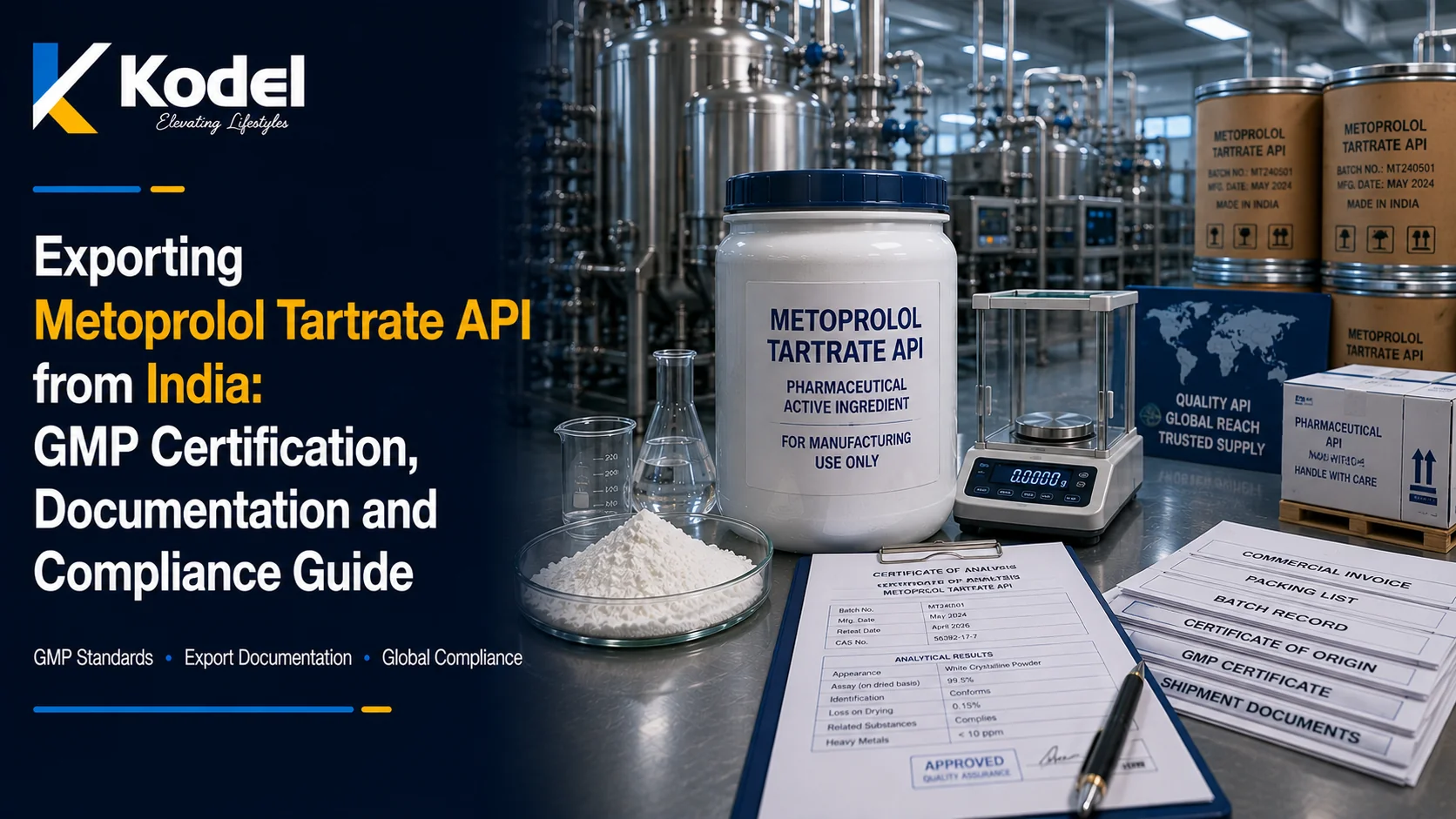
India exports Metoprolol Tartrate API to over 40 countries across five continents, making it one of the most globally traded cardiovascular APIs in the Indian pharmaceutical export portfolio. The molecule's combination of high finished-dose demand across diverse market segments, established synthesis infrastructure at Indian API facilities, and competitive cost structure has positioned Indian manufacturers as the primary global supply source for this molecule over the past two decades. Buyers in the European Union, United States, Middle East and North Africa, and Southeast Asia all source Metoprolol Tartrate API from India, each operating under different regulatory authority requirements that the Indian exporter must address in their documentation and quality system.
This guide covers the complete export process for Metoprolol Tartrate API from India: the GMP certification requirements by destination market, the documentation pack that a qualified exporter should provide, the HS code classification and customs implications, and the specific regulatory compliance checkpoints for EU, US, and MENA buyers. It is written for pharmaceutical procurement and import teams who are qualifying an Indian Metoprolol Tartrate API exporter for the first time, or who are reviewing their existing supplier's documentation against current regulatory expectations.
Why the Destination Market Determines Everything
No two destination markets require the same GMP standard from an Indian Metoprolol Tartrate API exporter. A WHO-GMP certificate issued by India's Central Drugs Standard Control Organisation qualifies an Indian exporter for supply to WHO prequalification tender markets and most semi-regulated markets in Southeast Asia, Sub-Saharan Africa, and the Middle East. That same certificate does not satisfy EU-GMP requirements for a European MA holder's drug substance sourcing, nor does it serve as a substitute for FDA inspection standing for a US ANDA filer. An Indian exporter who presents a WHO-GMP certificate to an EU buyer as evidence of EU compliance is providing an incorrect representation of their regulatory standing.
The starting point for any export qualification exercise is therefore confirming which regulatory authority the buyer's destination market requires to have inspected the Indian exporter's facility. For buyers sourcing metoprolol tartrate API for the first time from India, mapping the destination market to the required GMP standard before requesting documentation from any supplier prevents the wasted evaluation effort of receiving a WHO-GMP certificate from a supplier who cannot support EU or US regulatory filings.
GMP Certification Requirements by Destination Market
| Destination Market | Required GMP Standard | Regulatory Verification Source |
| United States | FDA GMP standing (EIR + no active import alert) | FDA Establishment Search + FOIA EIR |
| European Union / EEA | EU-GMP from European competent authority | EudraGMDP database |
| United Kingdom | MHRA GMP certificate | MHRA GMP register |
| Saudi Arabia (SFDA) | WHO-GMP + SFDA plant registration | SFDA portal |
| UAE (MOH / MOHAP) | WHO-GMP + product registration by importer | MOHAP import permit |
| Southeast Asia (ASEAN) | WHO-GMP (Thailand, Malaysia, Indonesia, Vietnam) | Market authority registration |
| Sub-Saharan Africa | WHO-GMP | NAFDAC, ZAMRA, PPB or equivalent |
| Latin America (ANVISA) | WHO-GMP + ANVISA product registration | ANVISA SCTIE database |
Kodel Life exports Metoprolol Tartrate API to 21 countries across 5 continents from the Morbi, Gujarat facility. The regulatory affairs team prepares destination-specific documentation packages for each shipment, covering WHO-GMP, EU-GMP, and FDA-compliant documentation as required by the buyer's destination market authority. Advance documentation requests for new market registrations are handled within one to two business days.
HS Code Classification for Metoprolol Tartrate API Export
Metoprolol Tartrate API export from India is classified under ITCHS code 29429000 under the Indian Trade Classification Harmonised System, mapping to international HS code 2942.00 for other organic compounds not classified elsewhere. This is the same HS code that applies to Metoprolol Succinate API and to most other pharmaceutical API molecules that do not have a dedicated HS chapter sub-heading at the six-digit level.
The HS code 2942.00 must appear on the Indian shipping bill, commercial invoice, and packing list. At the eight and ten-digit level, destination countries may apply specific sub-classifications that determine the applicable import duty rate and any controlled substance declaration requirement. Import duty rates for Metoprolol Tartrate API under HS 2942.00 range from zero percent in the US and EU under standard pharmaceutical ingredient MFN schedules to 5 to 10 percent in some MENA and Southeast Asian markets, with potential duty exemptions under applicable free trade agreements such as the India-ASEAN FTA for ASEAN member country imports.
Customs note: A mismatch between the ITCHS code on Indian export documents and the sub-classification in the destination country's import declaration is the most common source of customs clearance delays for Metoprolol Tartrate API shipments. Always obtain written HS code confirmation from the Indian exporter at order placement, cross-checked against the destination tariff schedule at the eight-digit level before the shipment is booked.
The Complete Export Documentation Pack for Metoprolol Tartrate API
A qualified Metoprolol Tartrate API exporter from India should be able to produce a complete documentation pack within five business days of a buyer's request. The pack covers eight document categories, each serving a distinct customs, regulatory, or quality function. A supplier who cannot produce all eight categories within the five-day window is signalling documentation readiness gaps that will recur at every commercial shipment.
Certificate of Analysis
Batch-specific COA referencing the applicable pharmacopoeial standard (IP, BP, USP, or EP) with numeric values for all compendial parameters including assay, optical rotation, related substances, water content (KF), residue on ignition, heavy metals, and any in-house specifications such as particle size. A Metoprolol Tartrate COA that omits the optical rotation result is missing a mandatory pharmacopoeial parameter.
GMP Certificate
GMP certificate issued by the authority applicable to the destination market - WHO-GMP from CDSCO for semi-regulated markets, EU-GMP from a European competent authority for EU supply, or FDA EIR documentation for US-market supply. The certificate must name the Metoprolol Tartrate API manufacturing line specifically and carry an inspection date within the last three years. For buyers who need a detailed explanation of the differences between WHO-GMP, EU-GMP, and FDA inspection standing, the guide to WHO-GMP, DMF and CEP compliance for Indian API manufacturers covers the regulatory architecture and verification steps for each certification type.
Material Safety Data Sheet
GHS-compliant MSDS prepared to UN GHS Revision 9 or later standard, including the CAS number for Metoprolol Tartrate (56392-17-7), IUPAC name, hazard classifications, first aid instructions, handling and storage requirements, and disposal guidance. For shipments to EU member states where local-language MSDS is required by national regulation, confirm with the buyer whether the MSDS must be provided in the local language alongside the English version.
Certificate of Country of Origin
COO issued by a recognised Indian chamber of commerce or the Export Inspection Council of India, confirming the API was manufactured in India. Required for customs clearance in most destination markets and for preferential duty rate claims under applicable free trade agreements. The COO must match the exporter name, product description, and HS code shown on the commercial invoice and shipping bill.
DEA Exemption Statement
Written confirmation that Metoprolol Tartrate is not a controlled substance under the US Controlled Substances Act and does not require a DEA import permit. Standard for US-bound shipments; a qualified exporter will have this as a pre-prepared standard document rather than a custom preparation for each shipment.
DMF Reference Letter or EDQM CEP
For US-market supply, an open reference letter authorising the ANDA filer to reference the exporter's FDA Drug Master File (DMF number must be stated and verifiable on accessdata.fda.gov). For EU-market supply, either a current copy of the EDQM Certificate of Suitability for Metoprolol Tartrate API (CEP reference and expiry date must be stated) or a Qualified Person declaration confirming EU-GMP compliance of the specific batch for MA holders whose dossier includes the full Module 3 drug substance section.
Shipping Bill and Commercial Invoice
Indian export shipping bill showing ITCHS code 29429000, declared value in the invoice currency, and net and gross weight per container. Commercial invoice showing buyer and seller registered names, PO reference, payment terms, unit price, and total value. Both documents must be consistent with each other and with the COA batch details.
Packing List
Detailed packing list identifying number of drums, net and gross weight per drum, batch number, manufacturing date, re-test date, and storage condition labels for each container. For Metoprolol Tartrate API: 'Store below 25 degrees Celsius, protected from moisture and light.'
EU-Specific Compliance Requirements for Metoprolol Tartrate API Import
EU import of Metoprolol Tartrate API from India carries the most demanding regulatory compliance requirements of any major destination market. The EU-GMP requirement for API manufacturing sites has no mutual recognition pathway with India as of 2026, meaning every Indian Metoprolol Tartrate API manufacturer supplying EU finished-dose buyers must have undergone a direct EU-GMP inspection by a European competent authority to obtain a valid EU-GMP certificate.
Beyond facility certification, each batch of Metoprolol Tartrate API released for EU finished-dose production requires a Qualified Person declaration from the EU manufacturer's site. This QP declaration is a legal document under EU pharmaceutical law confirming that the API batch was manufactured in compliance with EU-GMP, regardless of where the API was produced. EU buyers who import Metoprolol Tartrate API from an Indian supplier without an EU-GMP certificate, and without a QP declaration for each batch, have no legal pathway to batch release under EU Directive 2001/83/EC as amended.
EU compliance note: The QP declaration requirement applies to every API batch, not just to the first batch from a new supplier. An EU MA holder who has been receiving Metoprolol Tartrate API from the same Indian supplier for three years must still obtain a QP declaration for every batch. The obligation is continuous, not a one-time qualification event.
US-Specific Compliance: FDA Inspection Standing and ANDA Support
US import of Metoprolol Tartrate API from India requires that the Indian manufacturing facility has undergone a direct FDA inspection. Unlike the EU, where a competent authority inspection produces a formal EU-GMP certificate, FDA inspections are documented through Establishment Inspection Reports (EIRs) and, where observations are made, Form 483 observations and Warning Letters. A facility with a clean EIR and no active import alerts is considered FDA-compliant for API supply purposes.
For ANDA filing support, the Indian Metoprolol Tartrate API exporter must also have an active Type II DMF on file with the FDA. The ANDA filer references the DMF in their application; the FDA reviews the DMF during the ANDA cycle. Verify the DMF status independently on the FDA public database, confirming the DMF holder name matches the exporter's registered entity name and that the DMF has not been withdrawn or placed on inactive status.
The export documentation structure for US-bound Metoprolol Tartrate API shipments follows the same framework as other pharmaceutical APIs exported from India to the US. Buyers who have already navigated US import documentation for another Indian pharmaceutical API, such as furosemide, will find the HS code, DEA exemption, and commercial invoice requirements are consistent across molecules. The detailed US-bound documentation checklist in the article on furosemide API export from India covers each document category in full and applies directly to Metoprolol Tartrate API US-bound shipments.
MENA-Specific Compliance: Saudi Arabia, UAE and GCC
Middle East and North Africa markets represent a significant export destination for Metoprolol Tartrate API from India, driven by high cardiovascular disease prevalence and a large generic pharmaceutical manufacturing sector across the GCC. Saudi Arabia's Saudi Food and Drug Authority (SFDA) requires a WHO-GMP certificate from the Indian manufacturer as a condition for plant registration, which is a prerequisite for the API to be used in a product registered on the SFDA's product database. The plant registration process typically takes six to twelve months and requires an apostille-certified copy of the WHO-GMP certificate alongside a technical dossier covering the manufacturing site.
UAE import of Metoprolol Tartrate API requires the product to be registered by the UAE importer with the Ministry of Health and Prevention (MOHAP) or the relevant emirate health authority. The WHO-GMP certificate from the Indian manufacturer and a COA for the specific batch must accompany each shipment. Some UAE import permits require advance clearance for each consignment, with processing times of five to ten business days. Buyers in the UAE should confirm the specific import permit requirements with their UAE registered importer before scheduling the first Metoprolol Tartrate API shipment.
The Documentation Is Part of the Product
A Metoprolol Tartrate API batch that arrives at a destination port without a complete documentation pack is not a compliant delivery, regardless of the analytical quality of the API itself. Customs authorities, import registries, and finished-dose QP release teams all require specific documentation before the batch can be cleared, used in production, or released for commercial sale. The documentation is not administrative overhead. It is the regulatory evidence that the batch was manufactured correctly, by a certified facility, and exported in compliance with the importing country's pharmaceutical control requirements.
Buyers who are beginning a Metoprolol Tartrate API supplier qualification exercise and need the full context on manufacturing specifications, pharmacopoeial grade differences, injectable-grade requirements, and regulatory documentation depth should read the complete Metoprolol Tartrate API manufacturer guide before initiating documentation requests or sample orders.
Kodel Life's documentation team handles export compliance for all 21 destination countries across 5 continents. Contact info@kodellife.com or call +91 75023 33335 to request an export documentation pack, GMP certificate, or bulk pricing quotation for Metoprolol Tartrate API. Response within one to two business days.
Request Export Package Details: Contact Kodel Life for a complete Metoprolol Tartrate API export documentation pack including COA, GMP certificate, MSDS, COO, DEA exemption, and DMF reference letter. Email info@kodellife.com or call +91 75023 33335.