


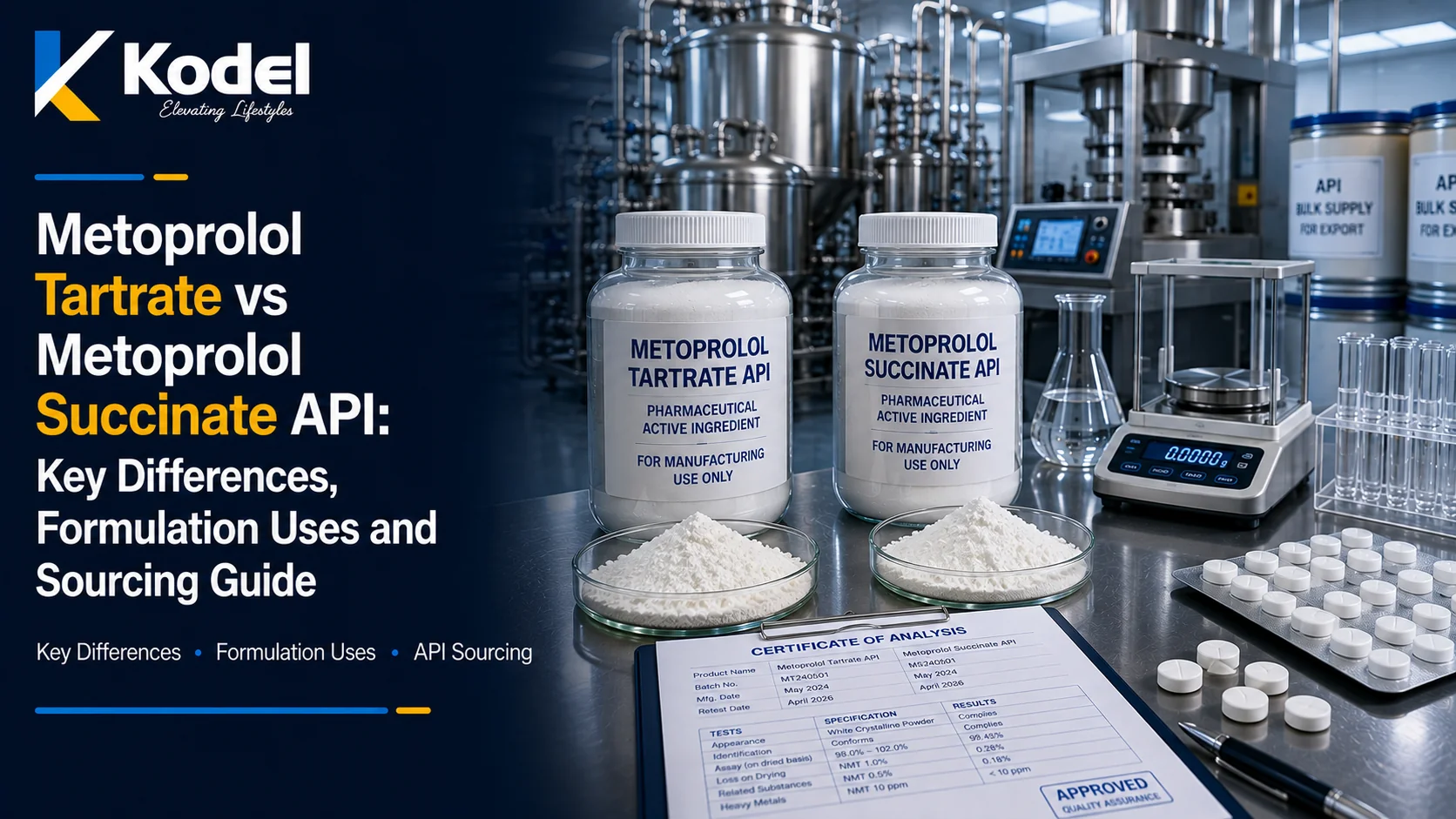
Pharmaceutical manufacturers sourcing metoprolol API for the first time, or expanding their cardiovascular API portfolio, frequently encounter the tartrate versus succinate decision without a clear framework for resolving it. The two salts share the same active moiety, the same therapeutic class, and the same primary indication profile. They differ in ways that are invisible on a price list but consequential at every stage from formulation development through to regulatory filing and commercial supply.
This article covers the key differences between Metoprolol Tartrate and Metoprolol Succinate API across seven dimensions: chemical identity, pharmacokinetics, formulation application, physical specification requirements, pharmacopoeial standards, regulatory documentation, and sourcing from India. The goal is to give procurement teams, formulation scientists, and regulatory affairs professionals a single reference that clarifies the decision before a purchase specification is written.
Chemical Identity: Same Active Moiety, Different Counter-Ions
Both Metoprolol Tartrate and Metoprolol Succinate are salts of metoprolol, the same beta-1 selective adrenoceptor antagonist active moiety. The difference lies in the acid used to form the salt. Metoprolol Tartrate uses L-tartaric acid (a diprotic acid with two carboxylic acid groups and two hydroxyl groups), producing a 2:1 metoprolol-to-tartrate molar ratio salt with molecular formula C34H56N2O12 and molecular weight 684.8 g/mol. Metoprolol Succinate uses succinic acid (a diprotic dicarboxylic acid without hydroxyl groups), producing a 2:1 metoprolol-to-succinate molar ratio salt with molecular formula C34H56N2O10 and molecular weight 652.8 g/mol.
The different counter-ions produce different crystal properties. The tartrate salt crystallises as a white powder with higher aqueous solubility and rapid dissolution kinetics. The succinate salt crystallises in a thermodynamically stable polymorphic form that supports extended-release tablet formulation through its controlled dissolution behaviour in ER matrix systems. These physical differences are the root cause of the formulation application divergence between the two salts.
Pharmacokinetics: Fast Onset vs Controlled Release
Metoprolol Tartrate, administered as an immediate-release oral tablet, produces peak plasma metoprolol concentrations within 1.5 to 2 hours and a half-life of approximately 3 to 7 hours, necessitating two to four-times-daily dosing for sustained therapeutic effect. The rapid absorption and clearance profile is appropriate for acute clinical situations including perioperative beta-blockade, acute hypertensive episodes, and arrhythmia management, where fast onset and predictable offset are clinically useful. Intravenous Metoprolol Tartrate for acute myocardial infarction management protocols achieves peak effect within minutes of administration, a clinical capability the succinate salt does not support.
Metoprolol Succinate in an extended-release tablet delivers metoprolol over a 24-hour period, producing a flatter plasma concentration profile with lower peak-to-trough fluctuation compared to Metoprolol Tartrate IR dosing. The MERIT-HF trial demonstrated that this controlled-release profile, administered once daily, produced a 34 percent reduction in all-cause mortality in patients with chronic heart failure. This outcome data, rather than any chemical superiority, is the reason Metoprolol Succinate has displaced Metoprolol Tartrate as the preferred salt for chronic heart failure maintenance therapy in major cardiology guidelines.
Formulation Applications: Where Each Salt Is Used
| Application | Metoprolol Tartrate | Metoprolol Succinate |
| Tablet dosage form | Immediate-release (IR) | Extended-release (ER) only |
| Dosing frequency | 2 to 4 times daily | Once daily |
| Injectable formulation | Yes (IV ampoule/vial) | Not used for injection |
| Primary indication | Hypertension, angina, arrhythmia, perioperative | Heart failure (NYHA II-IV), hypertension, angina |
| Key clinical trial | Established IR standard | MERIT-HF (mortality reduction) |
| Polymorph criticality | Low (IR dissolution tolerant) | High (ER dissolution sensitive) |
| Particle size criticality | Moderate (low strength IR tablets) | High (ER matrix dissolution control) |
| Kodel Life capacity | 62 MT per month | 20 MT per month |
Physical Specification Differences: Where API Grade Diverges
Optical Rotation
Metoprolol Tartrate carries an optical rotation specification arising from the chiral centre in the L-tartaric acid counter-ion. The USP specification is NLT +14.5 to +16.5 degrees (5 percent w/v solution). Metoprolol Succinate has no comparable optical rotation requirement, as succinic acid is achiral. Buyers transitioning between the two salts in their API specification development must add optical rotation testing to the Metoprolol Tartrate specification and remove it from the Succinate specification. A supplier whose COA for Metoprolol Tartrate does not include an optical rotation result is missing a pharmacopoeial specification parameter.
Polymorph Control
Polymorph control is a critical quality attribute for Metoprolol Succinate API because the polymorphic form of the succinate salt directly affects its dissolution behaviour in ER tablet matrices. For Metoprolol Tartrate used in IR tablet formulations, polymorph identity is less formulation-consequential because IR dissolution is driven by tablet disintegration rather than controlled-rate diffusion. However, buyers formulating injectable Metoprolol Tartrate solutions should confirm polymorph identity as part of their solubilisation validation. The detailed formulation implications of polymorph control for the succinate salt are covered in the guide to Metoprolol Succinate API for extended-release tablet formulation.
Moisture and Hygroscopicity
Both salts are moderately hygroscopic, but Metoprolol Tartrate has a slightly higher tendency toward moisture uptake due to the hydroxyl groups on the tartrate counter-ion. The pharmacopoeial water content limit for both salts is NMT 0.5 percent by Karl Fischer titration. Buyers storing Metoprolol Tartrate API in high-humidity environments should ensure sealed packaging and humidity-controlled storage below 60 percent RH to maintain moisture compliance across the re-test period.
Pharmacopoeial Standards: USP and BP Differences by Salt
Both Metoprolol Tartrate and Metoprolol Succinate are described in USP and BP/EP monographs with similar structural differences in assay limits and impurity thresholds. For Metoprolol Tartrate, the USP assay range is 98.0 to 102.0 percent on dried basis, and the BP/EP range is 99.0 to 101.0 percent. For Metoprolol Succinate, the same pattern applies. In both cases, buyers supplying the EU market must source material that meets the tighter BP/EP assay specification, not the broader USP range.
The impurity threshold differences between USP and BP/EP are also consistent between the two salts: USP limits any single related substance to NMT 0.2 percent, while BP/EP specifies NMT 0.1 percent for named impurities. For regulatory dossier submissions in both US and EU markets, buyers must confirm that their supplier's process consistently delivers batches within the tighter BP/EP impurity limits.
Regulatory Documentation: What Each Salt Requires
The regulatory documentation requirements for sourcing metoprolol tartrate API from India follow the same framework as the succinate salt: US FDA Type II DMF for ANDA support, EDQM CEP or full Module 3 documentation for EU MA support, and WHO-GMP certification for semi-regulated market supply. However, the DMF for Metoprolol Tartrate is a separate filing from the DMF for Metoprolol Succinate, even from the same manufacturer. A supplier who has a Metoprolol Succinate DMF does not automatically have a Metoprolol Tartrate DMF; verify the tartrate-specific DMF number independently on the FDA public database.
For injectable-grade Metoprolol Tartrate API, additional EU regulatory requirements apply around the sterile filtration compatibility of the API and GDP compliance for distribution through intermediaries. The full regulatory documentation requirements for Metoprolol Tartrate API sourcing, including injectable-grade specifications and destination-market differences for US, EU, and SEA buyers, are covered in detail in the complete Metoprolol Tartrate API manufacturer guide.
Sourcing Both Salts from a Single Indian Supplier: Advantages and Considerations
Pharmaceutical companies with a cardiovascular API portfolio that includes both immediate-release Metoprolol Tartrate and extended-release Metoprolol Succinate products can simplify their API supplier qualification programme by sourcing both molecules from the same Indian manufacturer. A single-supplier relationship for both salts reduces the regulatory burden of dual-supplier qualification, consolidates documentation management (GMP certificates, COAs, DMF reference letters, stability data) into one supplier contact, and creates volume leverage that may translate into preferential pricing and batch scheduling priority.
The trade-off is concentration risk: a single-supplier arrangement for both molecules increases exposure to facility-level disruption events. Buyers who consolidate both metoprolol salt forms with one manufacturer should maintain qualification documentation for at least one backup supplier for each molecule. The full specification landscape for the succinate salt, including capacity figures, ER-grade physical specification requirements, and regulatory documentation depth, is covered in the Metoprolol Succinate API complete manufacturer guide.
Kodel Life: Kodel Life manufactures both Metoprolol Tartrate API (62 MT per month) and Metoprolol Succinate API (20 MT per month) from the Morbi, Gujarat facility, with dedicated synthesis lines for each salt form operating under separate validated process parameters. Buyers sourcing both molecules from Kodel Life receive a consolidated regulatory documentation package with separate COAs, DMF reference letters, and stability data summaries for each salt, prepared to the buyer's specific destination market requirements.
Match the Salt to the Formulation, Then Match the Supplier to the Specification
The tartrate versus succinate API decision is resolved by the finished dosage form, not by the API market. If the product is an immediate-release tablet or an injectable, the salt is Metoprolol Tartrate. If the product is an extended-release tablet, the salt is Metoprolol Succinate. The API sourcing decision that follows is a separate exercise, governed by the supplier's GMP certification, pharmacopoeial grade availability, regulatory documentation depth, and process consistency evidence for the specific salt form required.
Kodel Lifescience LLP supplies both salt forms to IP, BP, USP, and EP pharmacopoeial standards from dedicated synthesis lines at Morbi, Gujarat. Contact info@kodellife.com or call +91 75023 33335 to request Certificates of Analysis, DMF reference letters, or bulk pricing quotations for either or both metoprolol API salt forms.
Download Metoprolol API Comparison Chart. Contact Kodel Life to receive the Metoprolol Tartrate vs Succinate API comparison chart as a PDF, including pharmacopoeial specs, capacity figures, and regulatory documentation checklist for both salt forms. Email info@kodellife.com or call +91 75023 33335.