

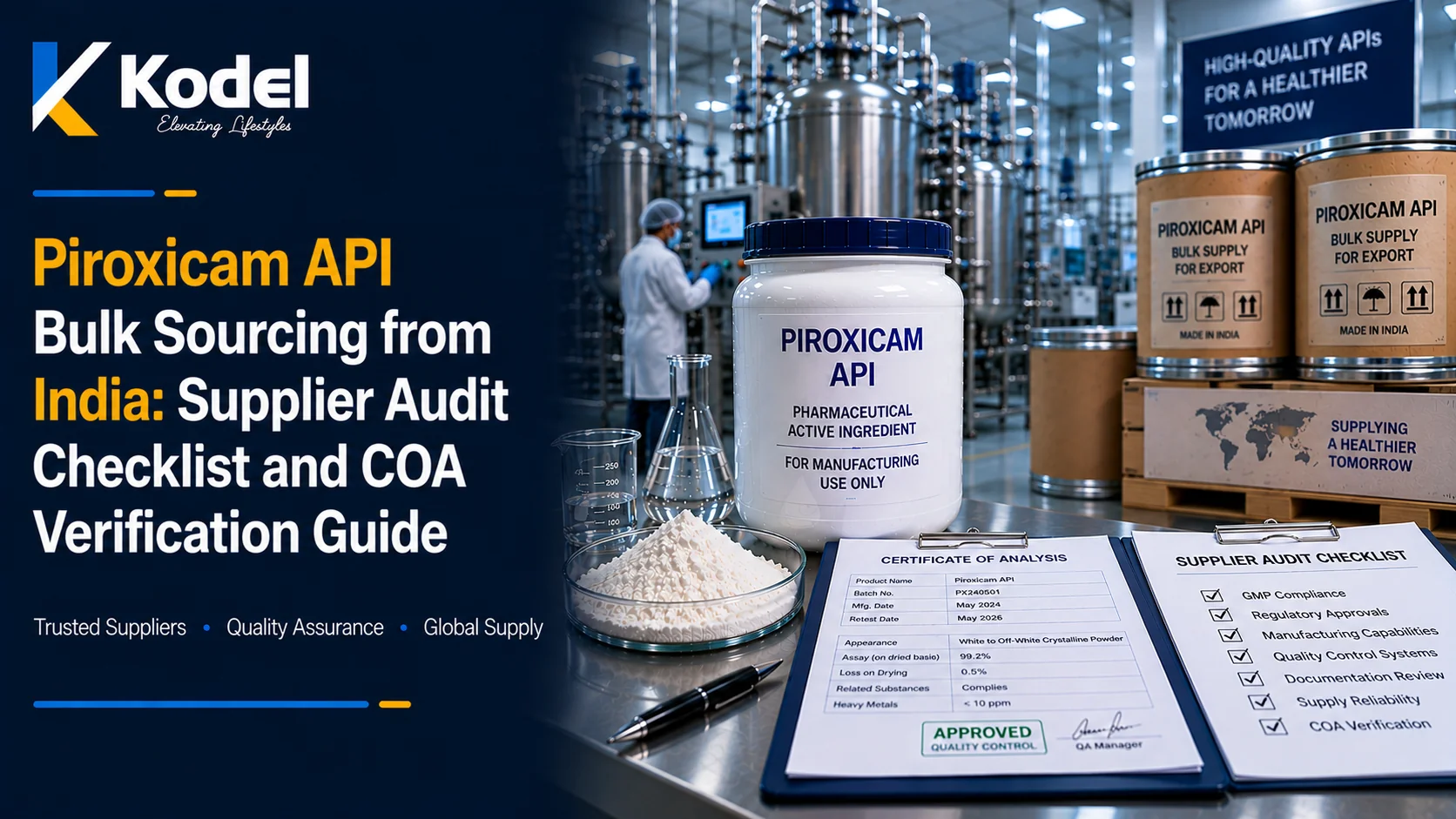
Pharmaceutical manufacturers sourcing Piroxicam API from India in bulk encounter a supplier landscape with significant variation in quality documentation depth, polymorphic form control, and regulatory certification standing. The market for Piroxicam API from India includes manufacturers whose documentation depth and quality system rigour match global regulated-market expectations, and others who supply compendial-grade material on the COA while operating without the process controls that predict batch-to-batch consistency across commercial supply. The procurement exercise that distinguishes between these two categories is not difficult, but it requires asking the right questions and reviewing the right documents in a structured sequence.
This guide provides a step-by-step supplier audit and COA verification framework for Piroxicam API bulk sourcing from India. It covers the document categories to request, the specific parameters to review within each document, and the red flags that should disqualify a supplier from your approved vendor list before a commercial order is placed.
Step 1: Establish Destination Market Requirements Before Approaching Suppliers
The GMP certification, regulatory filing support, and documentation depth requirements for a Piroxicam API supplier vary by the destination market in which the finished-dose product will be sold. A buyer sourcing Piroxicam API for a WHO prequalification tender product needs WHO-GMP certification, a pharmacopoeial COA, and a COO. A buyer sourcing for a US ANDA needs a supplier with FDA inspection standing and an active Type II DMF. A buyer sourcing for an EU MA needs a supplier with EU-GMP certification from a European competent authority and either an EDQM CEP or a QP declaration for each batch.
Confirming which regulatory authority standards apply to your destination market before approaching suppliers prevents the wasted evaluation effort of receiving documentation from a supplier who meets WHO-GMP standards but cannot support your EU or US regulatory filing. A full overview of Piroxicam API manufacturing standards, pharmacopoeial grades, and regulatory documentation requirements by market is available on the Piroxicam API product.
Step 2: The Pre-Qualification Document Request
Before placing a sample order or a commercial order, send every prospective Piroxicam API bulk supplier a structured pre-qualification document request covering seven document categories. A supplier who cannot respond completely within five business days is indicating documentation readiness gaps that will recur at every shipment in a commercial supply relationship.
Document 1: Certificate of Analysis from a Recent Commercial Batch
Request a COA from a commercial-scale batch manufactured within the last six months. The COA must reference a specific pharmacopoeial edition (USP 47, BP 2024, or Ph. Eur. 11.0), include numeric results for all compendial parameters, report the assay as a percentage (not as 'complies'), and include the melting point range as a first-line polymorph screening result. A Piroxicam COA reporting a melting point below 190 degrees Celsius is a polymorph alert requiring XRPD investigation before accepting the batch.
Document 2: XRPD Diffractogram for Polymorph Confirmation
Request the XRPD diffractogram from the same batch as the COA, with an overlay comparison to the Form I reference standard. Confirm that the XRPD result is issued by the manufacturer's own QC laboratory or by an accredited contract testing laboratory, and that it is date-stamped to the same batch number as the COA. A XRPD report without a batch number reference, or one issued months before the COA date, is not a batch-specific polymorph confirmation.
Document 3: Particle Size Distribution Report
Request the particle size distribution report showing D10, D50, and D90 values measured by laser diffraction, from the same batch as the COA. For Piroxicam API, the D90 value is the most formulation-critical parameter given the molecule's low aqueous solubility. Request this data across three consecutive commercial batches to assess consistency, not just for the batch being offered for sale.
Document 4: ICH Q3A Named Impurity Profile
Request the impurity profile document, not just the COA related substances section. The profile document should name each identified impurity above the 0.10 percent identification threshold by chemical name or assigned code, state the HPLC limit in the specification, and confirm ICH Q3A qualification status. Any impurity above 0.10 percent listed only as 'unknown' is unqualified under ICH Q3A and will generate a regulatory reviewer query in your ANDA or EU MA dossier.
The ICH Q3A framework for Piroxicam API includes a specific ICH M7 genotoxic impurity assessment requirement for saccharin, the synthesis starting material. The full context for these impurity documentation requirements, including the ICH M7 assessment rationale and the process-related impurities arising from each step of the Piroxicam synthesis route, is covered in the complete guide to Piroxicam API manufacturing and quality standards.
Document 5: GMP Certificate
Request the GMP certificate applicable to your destination market, with the issuing authority name, certificate scope, and inspection date clearly stated. Verify the certificate independently: WHO-GMP certificates through the WHO Prequalification database, EU-GMP certificates through EudraGMDP, and FDA inspection standing through the FDA establishment search. Certificates more than three years old without a documented re-inspection should be treated as lapsed for regulatory filing purposes.
Document 6: DMF Reference Letter or EDQM CEP
For US market supply, request a DMF open part reference letter with the FDA DMF number stated. Verify the DMF number independently on the FDA Drug Master File database. For EU market supply, request the EDQM CEP copy with the CEP reference number and confirm status on the EDQM database. A supplier who claims to have a DMF or CEP but cannot provide a verifiable reference number within five business days should be treated as unregistered.
Document 7: ICH Q1A Stability Data Summary
Request the stability data summary with numeric results at each ICH Q1A time point for long-term (25 degrees Celsius / 60 percent RH) and accelerated (40 degrees Celsius / 75 percent RH) conditions, from a commercial-scale batch. Confirm that the stability protocol includes XRPD polymorph monitoring at each time point, not only assay and related substances testing. For Piroxicam API, polymorphic conversion during storage is the primary stability risk, and a stability programme without XRPD monitoring is not adequate.
The Piroxicam API Supplier Audit Checklist
| Audit Criterion | What Good Looks Like | Red Flag - Disqualify or Escalate |
| GMP Cert | Active cert from required authority; scope names Piroxicam line; dated within 3 years | Cert >3 years old; scope covers only general facility; issuing authority unclear |
| DMF / CEP | Active DMF number verifiable on FDA database; or valid CEP on EDQM database | Cannot provide DMF/CEP number; number not verifiable; 'in process of filing' |
| COA - Assay | Numeric % (e.g. 99.4%); references USP 47 or BP 2024 edition | 'Complies' without %; no pharmacopoeial edition stated |
| COA - Melting Point | 198–200°C (Form I); numeric result stated | Below 190°C; 'complies with range' without value |
| XRPD - Polymorph | Batch-specific Form I confirmation; overlay vs reference; dated to batch | Tested on request only; no batch reference; 'same as previous' |
| Particle Size | D10, D50, D90 by laser diffraction; 3 consecutive batch data available | Bulk density only; 'within limits' without values; no 3-batch data |
| Impurity Profile | Named impurities; ICH Q3A status; ICH M7 saccharin assessment confirmed | 'Unknown impurity at RRT X.XX' above 0.10%; no ICH M7 assessment |
| Stability Data | Numeric results at each ICH Q1A time point; XRPD at each point | Conclusion-only summary; no XRPD at stability time points; extrapolated |
| Response Time | Complete 7-document pack within 5 business days | >5 days; incomplete pack; verbal assurances without documents |
COA Verification in Detail: What Each Piroxicam Parameter Tells You
Assay: The Purity Foundation
The Piroxicam API assay result, determined by HPLC and reported as a percentage on dried basis, must fall within the pharmacopoeial specification: 98.0 to 102.0 percent for USP or 99.0 to 101.0 percent for BP/Ph. Eur. The numeric result, not a 'complies' declaration, is the only analytically meaningful way to report assay data. A result of 98.2 percent satisfies USP but fails BP/Ph. Eur.: for buyers supplying both US and EU markets, dual-market compliance requires a result within the tighter 99.0 to 101.0 percent range.
Melting Point: First-Line Polymorph Screen
The melting point result on the Piroxicam COA serves as the first-line polymorph screen. Form I melts at 198 to 202 degrees Celsius (USP) or 198 to 200 degrees Celsius (BP/Ph. Eur.). A melting point below 190 degrees Celsius indicates a metastable polymorph or mixed polymorphic batch. The melting point is not a substitute for XRPD polymorph identification - it is a complementary test that provides a rapid alert before the XRPD result is reviewed - but a COA without a numeric melting point result is missing one of the two polymorph screening tools available at batch release.
Related Substances: Named vs Unknown
The related substances section of the Piroxicam COA should report individual impurity levels as named compounds (saccharin residual, N-methylsaccharin, oxalyl chloride condensation by-product) or as assigned impurity codes with HPLC retention time references. A COA that lists impurities only by relative retention time without chemical name identification for any impurity above 0.10 percent contains unqualified impurities under ICH Q3A, which will require resolution during regulatory dossier review.
The COA verification framework for Piroxicam API parallels the structured supplier evaluation approach developed for furosemide API sourcing, where the same parameters - numeric assay values, named impurity reporting, re-test date adequacy, and GMP certificate verification - apply across both molecules. Buyers who have previously navigated furosemide API supplier qualification will find the systematic approach in the furosemide API supplier evaluation guide directly applicable to their Piroxicam sourcing exercise.
Loss on Drying vs Moisture Content
The Piroxicam monograph specifies loss on drying (LOD) rather than moisture content by Karl Fischer titration. LOD captures both water and volatile solvents lost during heating. The pharmacopoeial limit is NMT 0.5 percent for both USP and BP. Batches close to the 0.5 percent LOD limit should be reviewed against the residual solvent specification (ICH Q3C) to confirm whether the LOD value reflects water content or residual synthesis solvent. A batch with LOD of 0.45 percent and a confirmed ICH Q3C residual solvent result within limits is analytically acceptable. A batch with LOD of 0.45 percent and no residual solvent data is ambiguous.
On-Site vs Remote Audit: What to Cover for Piroxicam API
A remote document audit using the seven-document pre-qualification pack is the appropriate first step for any new Piroxicam API supplier. On-site audits are warranted when the document audit raises unresolved questions about the facility's quality system, when the supplier is being added as a primary source for a regulated-market finished-dose product, or when the buyer's own quality management system requires on-site vendor qualification for drug substance suppliers.
An on-site audit of a Piroxicam API manufacturer should cover five specific areas beyond what is visible in the pre-qualification document pack: the crystallisation area and process control records (confirming that the recrystallisation step has validated CPPs and that XRPD in-process control is actively used); the QC laboratory and instrument calibration records (confirming HPLC system suitability records, XRPD reference standard maintenance, and particle size instrument calibration); the batch manufacturing record for a recent Piroxicam batch (confirming that IPC results are recorded and reviewed as part of batch disposition); the stability room and stability records (confirming that the stability chamber is calibrated and that polymorph monitoring is included in the stability protocol); and the change control log (confirming that any changes to the crystallisation solvent, temperature profile, or drying conditions have been captured in a change control record and assessed for their impact on polymorph identity).
Comparing Piroxicam API Suppliers: Price Is the Last Criterion
Procurement teams who use price as the primary Piroxicam API supplier selection criterion and qualify on quality documentation only as a secondary check are reversing the correct evaluation sequence. The cost of discovering a polymorph inconsistency or an unqualified impurity after a commercial supply relationship has been established, and after the finished-dose product's registration dossier has been submitted, is measured in regulatory response cycles, scale-up failures, and market entry delays that dwarf the per-kilogram API price difference between a thorough supplier and a cheap one.
A structured pre-qualification scoring approach that weights documentation depth, polymorph control evidence, and regulatory standing more heavily than price is the evaluation model that protects the buyer's downstream commercial interests. The five-parameter quality scoring framework for metoprolol API COA review - adapted here for Piroxicam by substituting polymorph identity by XRPD and particle size for ER-grade formulation parameters - is described in the Metoprolol Succinate API quality parameters checklist and provides a practical template for structuring the comparative supplier assessment.
Kodel Life supplies Piroxicam API with XRPD Form I polymorph confirmation as a standard batch release specification, particle size D10/D50/D90 data from laser diffraction, a named ICH Q3A impurity profile, ICH M7 saccharin assessment documentation, and ICH Q1A stability data with XRPD at each time point. The seven-document pre-qualification pack is available within two business days of a qualified enquiry. Contact info@kodellife.com or call +91 75023 33335.
The Audit Is the First Investment in the Supply Relationship
A Piroxicam API supplier audit is not a bureaucratic compliance exercise. It is the mechanism by which a buyer confirms that the quality system supporting the supplier's COA is real, that the polymorph control described in their process documentation operates consistently in commercial production, and that the impurity profile submitted with the pre-qualification pack reflects the actual chemistry of their synthesis route. A supplier who welcomes the audit and provides complete documentation promptly is demonstrating a quality culture that will serve the supply relationship well when a quality event requires transparent joint investigation.
Request the seven-document pre-qualification pack from Kodel Lifescience for Piroxicam API within two business days. Contact info@kodellife.com or call +91 75023 33335 to initiate a supplier qualification exercise.