


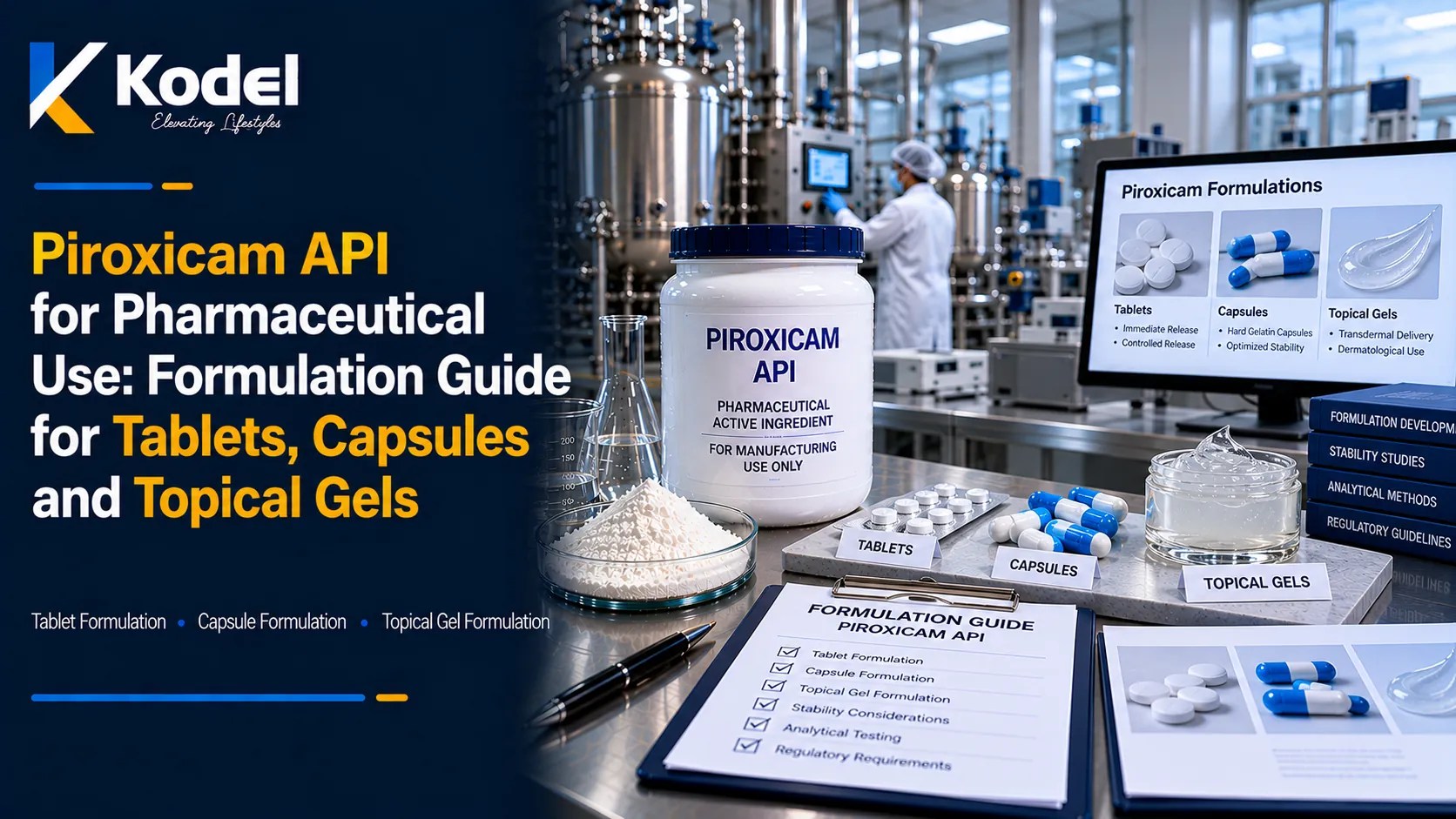
Piroxicam API presents pharmaceutical formulation scientists with a specific and well-characterised set of challenges. The molecule's low aqueous solubility limits the dissolution rate of oral solid dosage forms. Its polymorphic behaviour introduces a stability risk that can manifest as dissolution rate decline over product shelf life. Its once-daily dosing convenience, arising from a plasma half-life of 30 to 86 hours, is the primary clinical advantage that the formulation must preserve without introducing bioavailability variability. And its application across three primary dosage form categories - oral tablets, oral capsules, and topical gels for localised NSAID therapy - means that formulation teams working with Piroxicam API must address different API physical specification requirements depending on the dosage form they are developing.
This guide covers the formulation considerations specific to Piroxicam API across all three major dosage form categories: the solubility and dissolution challenges for oral tablets and capsules, the bioavailability enhancement strategies available, the physical API specifications that most directly affect formulation performance, and the excipient compatibility profile relevant to Piroxicam formulation development. It is written for formulation scientists, R&D teams, and pharmaceutical manufacturers who are sourcing Piroxicam API for new product development or for generic registration programmes.
Piroxicam API Physical Properties: The Formulation Starting Point
Piroxicam (CAS 36322-90-4, MW 331.3 g/mol) is a yellow to light yellow crystalline powder classified as a BCS Class II drug substance: low aqueous solubility and high intestinal membrane permeability. Its aqueous solubility at 25 degrees Celsius is approximately 0.007 mg/mL at neutral pH (7.4), increasing to approximately 0.3 mg/mL at pH 6.0 and to greater than 5 mg/mL at pH 7.8 due to the molecule's phenolic pKa of approximately 5.1 and its amphoteric character from the pyridyl nitrogen. This pH-dependent solubility profile is important for understanding the in vivo dissolution behaviour of Piroxicam tablets in the gastrointestinal tract and for designing dissolution test conditions that are biorelevant.
The log P (octanol-water partition coefficient) of Piroxicam is approximately 0.35 at neutral pH, indicating moderate lipophilicity. The combination of low aqueous solubility at intestinal pH, moderate lipophilicity, and high permeability defines the BCS Class II classification and directs the formulation strategy: for oral solid dosage forms, the rate-limiting step for absorption is dissolution, not permeation, so formulation effort should focus on maximising dissolution rate through particle size reduction, wettability enhancement, or solubilisation techniques.
Tablet Formulation: Addressing the Dissolution Rate Challenge
Particle Size and Specific Surface Area
For BCS Class II drugs like Piroxicam, particle size reduction is the most direct and most widely validated approach to increasing dissolution rate in oral tablet formulations. Reducing the D90 of Piroxicam API increases the specific surface area available for dissolution, which for a diffusion-limited dissolution process translates directly into faster drug release rates. The dissolution rate increase from particle size reduction follows the Noyes-Whitney equation: as the particle radius decreases, the dissolution rate increases proportionally to the increase in surface area per unit mass.
Most Piroxicam tablet formulations achieving USP dissolution compliance (NLT 70 percent dissolved in 45 minutes in 0.1 N HCl for the USP dissolution test) require a D90 below 100 microns. Formulations targeting faster dissolution profiles or operating with lower API loading may require D90 below 50 microns. Buyers should specify the required D90 range in their API purchase specification before formulation development begins and confirm that their supplier can provide D10, D50, and D90 data from laser diffraction with batch-to-batch consistency evidence. Full particle size specification and availability for Piroxicam API are confirmed on the Piroxicam API.
Wettability Enhancement
Piroxicam API has a contact angle with water that indicates poor wettability: the dry API powder does not readily wet with water without surfactant assistance, which means the dissolution rate in simple aqueous media is slower than would be predicted from particle size alone. The standard wettability enhancement technique for Piroxicam tablet formulations is the inclusion of a hydrophilic surfactant such as sodium lauryl sulphate (SLS) at 0.5 to 1.0 percent of the tablet weight, or the use of a solubilising excipient such as polyethylene glycol 6000 (PEG 6000) as part of a melt granulation approach. Both strategies increase the effective dissolution rate of the API by reducing the contact angle at the particle-water interface.
USP Dissolution Test for Piroxicam Tablets
The USP dissolution test for Piroxicam tablets uses Apparatus 2 (paddle) at 50 rpm in 900 mL of 0.1 N hydrochloric acid at 37 degrees Celsius, with a single time point acceptance criterion of NLT 70 percent dissolved in 45 minutes. The acidic dissolution medium (pH approximately 1.2) reflects the gastric environment but does not capture the pH-dependent solubility increase that occurs as Piroxicam moves from the stomach to the small intestine. For development purposes, a biorelevant dissolution test using simulated gastric fluid (SGF) followed by simulated intestinal fluid (SIF) at pH 6.8 provides a more predictive in vitro model of the in vivo dissolution and absorption behaviour of Piroxicam tablets.
Capsule Formulation: Powder and Fill Considerations
Piroxicam is available in capsule dosage forms (typically 10 mg and 20 mg hard gelatin or HPMC capsules) in many markets. Capsule formulation of Piroxicam API requires attention to the same particle size and wettability considerations as tablet formulation, with the additional constraint that the powder blend must have adequate flow properties for capsule filling equipment.
Piroxicam API in its standard crystalline form has moderate flow characteristics. The Carr's index of the API varies with the crystallisation conditions used in manufacturing, ranging from approximately 20 to 35 percent (poor to passable flow by standard Carr's index classification). Capsule formulations at 10 mg to 20 mg Piroxicam loading (where the API represents 5 to 15 percent of the total fill weight) are less sensitive to API flow properties than the bulk filler blend, since the high-dose diluent (typically microcrystalline cellulose or lactose monohydrate) dominates the blend's flow behaviour. However, for powder-fill capsule formulations with API loadings above 30 percent, the API's flow properties become a significant variable in fill weight consistency and content uniformity.
One capsule-formulation-specific polymorphism concern that differs from tablet formulation is the potential for API polymorphic conversion during accelerated stability storage of capsules in high-humidity conditions. Hard gelatin capsules absorb moisture from their environment and can transmit that moisture to the API fill during storage at 40 degrees Celsius / 75 percent RH (ICH Q1A accelerated stability conditions), potentially facilitating conversion from Piroxicam Form I to the hydrate form. HPMC capsules are less hygroscopic and may reduce this risk. The full context for Piroxicam polymorphic forms, their dissolution implications, and the XRPD monitoring approach required during stability testing is covered in the complete Piroxicam API manufacturer guide.
Topical Gel Formulation: Piroxicam API for Localised NSAID Therapy
Piroxicam 0.5 percent topical gel is an established dosage form for localised musculoskeletal NSAID therapy, providing anti-inflammatory efficacy at the application site with lower systemic exposure than the same dose administered orally. The topical gel formulation presents different API physical specification requirements than oral solid dosage forms: particle size is critical for aesthetics (visible particles in a gel are unacceptable) and for skin penetration kinetics, solubilisation is a primary formulation challenge given Piroxicam's low water solubility, and the polymer gel matrix must maintain physical stability without API crystallisation over the product's shelf life.
Solubilisation in Topical Gel Vehicles
Piroxicam at 0.5 percent concentration (5 mg/g) in a standard hydrogel vehicle exceeds the aqueous solubility of the drug at pH 7.4 (approximately 0.007 mg/mL), meaning the formulation must incorporate co-solvents or solubilising agents to maintain the API in solution throughout the gel. The most widely used co-solvents for Piroxicam topical gel formulations are ethanol (typically 30 to 50 percent w/w), propylene glycol (5 to 15 percent w/w), or polyethylene glycol 400 (10 to 20 percent w/w), used individually or in combination. The co-solvent system must maintain Piroxicam solubility across the expected storage temperature range (typically 2 to 30 degrees Celsius) without causing physical phase separation or crystallisation of the API in the gel matrix.
API Particle Size for Topical Applications
For topical gel formulations where the API is intended to be fully dissolved in the co-solvent system, the API particle size is less critical than for oral solid dosage forms, since the rate-limiting step is solubilisation in the co-solvent system rather than dissolution from a solid particle surface. However, if the API is not fully dissolved during gel preparation - due to co-solvent insufficiency, manufacturing temperature variation, or API quality variation - residual undissolved API particles must be below 25 microns to avoid the grittiness that would make the product aesthetically unacceptable to patients. Most topical gel manufacturers specify a D90 below 25 microns for Piroxicam API used in 0.5 percent gel formulations.
Polymorphic Stability in Topical Gels
Piroxicam's polymorphic behaviour is a topical gel stability concern because the dissolved API can crystallise out of solution during storage if the co-solvent system is insufficient to maintain full solubility at the storage temperature. If crystallisation occurs, the polymorph that precipitates may be the metastable Form II or Form III rather than the thermodynamically stable Form I, because precipitation from solution is a kinetically controlled process. A topical gel stability programme should include API crystallisation monitoring by microscopy and XRPD of the gel matrix at each stability time point, not only assay and physical appearance measurements.
Excipient Compatibility for Piroxicam Oral and Topical Formulations
Oral Tablet and Capsule Compatibility
Piroxicam API is chemically compatible with most standard oral tablet excipients: microcrystalline cellulose, lactose monohydrate, mannitol, dibasic calcium phosphate, croscarmellose sodium, crospovidone, sodium starch glycolate, magnesium stearate, and povidone K30. The primary excipient compatibility concern is the interaction of Piroxicam with alkaline excipients such as calcium carbonate or sodium bicarbonate, which can shift the microenvironmental pH at the API-excipient interface and affect the degradation rate of Piroxicam under stress conditions. Formulators using a buffering agent to manage Piroxicam's pH-dependent solubility should conduct forced degradation compatibility studies confirming that the alkaline excipient does not elevate the degradation rate under the formulation's intended storage conditions.
The excipient compatibility evaluation approach for Piroxicam tablets parallels the systematic co-compatibility study framework applicable to other poorly soluble API formulations. Formulators who have developed excipient compatibility protocols for other low-solubility APIs will find the same experimental design applicable to Piroxicam - binary mixing studies at elevated temperature and humidity, followed by HPLC stability indicating method analysis. The formulation development approach for another challenging oral API, including excipient selection and dissolution optimisation strategy, is detailed in the Metoprolol Succinate API tablet formulation guide, which covers analogous dissolution-critical API formulation principles.
Topical Gel Compatibility
For topical gel formulations, Piroxicam is compatible with carbomer (Carbopol) gel bases neutralised with triethanolamine or sodium hydroxide, hydroxypropyl methylcellulose (HPMC) gel bases, and poloxamer gel bases. Incompatibility has been reported with some cationic polymers, which can interact with the anionic form of Piroxicam at physiological pH through ionic interaction, reducing the gel's viscosity and potentially affecting API release kinetics. The neutralised form of carbomer (at pH 6.5 to 7.5) is the most widely validated gel base for Piroxicam 0.5 percent topical formulations in regulatory submissions.
API Specifications to Request From Your Piroxicam Manufacturer Before Formulation
Formulation scientists initiating Piroxicam oral tablet, capsule, or topical gel development should request a specific set of physical and chemical characterisation data from their API supplier before placing even a development-scale order. The data request ensures that the formulation is developed against a defined, controlled API physical profile, not against a single batch whose properties may not represent the commercial supply profile.
The physical and process characterisation data most relevant to Piroxicam formulation development - including the crystallisation step parameters that control particle size and polymorph identity, and the residual solvent profile from the recrystallisation solvent system - are explained in the context of the manufacturing process in the article on how Piroxicam API is manufactured. Understanding the process context helps formulation scientists frame the right characterisation data requests to their supplier.
| Data Category | Parameter Needed | Relevance to Formulation |
|---|---|---|
| Particle Size | D10, D50, D90 by laser diffraction; 3 batch data | Dissolution rate control for oral forms; appearance in topical gels |
| Polymorph Identity | XRPD Form I confirmation; DSC thermogram | Dissolution stability; gel crystallisation risk |
| Bulk / Tapped Density | Carr's index; tapped density | Capsule fill weight consistency; blend flow |
| Residual Solvents | ICH Q3C Class 2 results (DMF if used) | Formulation compatibility; patient safety |
| pH-Solubility Profile | Solubility at pH 1.2, 4.5, 6.8, 7.4 | Dissolution medium design; biorelevant modelling |
| Stability Data | ICH Q1A with XRPD at each time point | Shelf life confirmation; polymorph conversion risk |
Kodel Life provides a complete physical characterisation package for Piroxicam API on request for qualified formulation development enquiries. The package includes COA with numeric pharmacopoeial results, XRPD Form I polymorph confirmation, DSC thermogram, particle size D10/D50/D90, bulk and tapped density with Carr's index, ICH Q3C residual solvent data, pH-solubility profile, and ICH Q1A stability data summary with XRPD monitoring. Technical data sheet requests are processed within two business days. Contact info@kodellife.com or call +91 75023 33335.
The Formulation Succeeds When the API Specification Is Right
Piroxicam's BCS Class II characteristics mean that every formulation decision, from the tablet granulation solvent to the topical gel co-solvent concentration, is influenced by the API's physical properties. A formulation developed without a controlled API particle size specification, or without XRPD polymorph confirmation from the same batch used in development stability studies, is built on an unknown foundation. The clinical advantage of once-daily Piroxicam dosing is preserved only when the dissolution profile is consistent across the product's shelf life and across commercial batches manufactured from API sourced over years of supply.
Formulation scientists working with Piroxicam API from Kodel Life receive full physical characterisation data, XRPD Form I confirmation, and batch-to-batch consistency evidence before development begins, building the formulation on a defined and controlled API physical profile. Contact info@kodellife.com or call +91 75023 33335 to request a formulation support package.